Pacific Coast Iris Culture
Pacific Coast Irises are a beardless iris of the series Californicae, and are usually labeled as PCIs. Iris x pacifica refers to a hybrid of related species within the Californicae series. They are generally small, compact plants with slender, wiry rhizomes, and narrow grass-like leaves. Most PCIs are evergreen, growing 6 to 24 inches high, with plants of the species, Iris munzii, sometimes reaching to 36 inches. In the garden, PCIs develop most easily under conditions similar to those of their natural habitat.Wild PCIs inhabit the western coast of North America, from the San Bernardino Mountains near Los Angeles north to the central coast of Washington, and from the shores of the Pacific Ocean to the western slopes of the Sierra Nevada in California and the Cascades in Oregon and Washington. Some flourish in full sun near the coast, but most live in lightly wooded areas and on sloping ground that is gritty, well drained, neutral to slightly acidic, and with considerable humus. Moisture comes mainly during the winter months as either rain or snow, depending on the elevation. Summers are normally long and dry, but the plants may receive significant moisture from summer thundershowers or as drip from dew.
Soil Conditions
The most important factor in the garden is good drainage. PCIs do not tolerate soils with stagnant water. Stagnation or excessive water promotes root damage and various diseases from which the plants cannot recover. In most areas, some summer watering is required to keep them alive, but do not water in the heat of the day!
PCIs can grow naturally in a wide range of soils, but the garden hybrids tend to do best in slightly to moderately acid (pH 5.5 to 6.5) soil to which considerable peat or humus has been added. In gardens located near the coast they can tolerate full sun, but inland it is best to plant them in a part of the garden where they receive moderate shade during the hottest part of the day.
Seeds
PCIs are easiest to grow from seed, planted up to inch deep in a gritty, barky soil mix. Dried seed seems to require a couple of months of exposure and moisture before it will germinate, but research has shown that cold is not required. Not all seeds germinate, and not all seedlings survive, but those that reach 3 inches tall in their pot should do well outside.
Another option to prepare seeds for germination is combining cold stratifying and soaking. Put seeds in a mesh bag, or a section of used pantyhose, secure the top and label. Put the bag in the water reservoir (tank) of the toilet. Leave to chill and soak for 3 weeks, then remove and plant immediately. This method gives the seeds two treatments at once: ample water to soak in, with regular changes each time the toilet is flushed, and temperatures in the 45-50°F (7-10°C) range, which is ideal for cool stratification for PCIs.
Like other seedlings, PCIs started indoors should be hardened off for a time outdoors in their pots in a sheltered spot before transplanting. Then carefully separate individual plants and set them out 6-12 inches apart at the same depth that they were growing in the pot. In extreme conditions it is best to separate seedlings into individual pots to grow until established, then plant out. PCIs can also be grown from seed directly in the garden.
Transplanting
PCIs are most successfully moved when their roots are plump, white, and actively growing. This happens when they receive regular water from either Man or Nature. Fall is usually the best season to transplant because their roots actively begin growing with the return of autumn rain. To tell if your PCIs are ready for lifting, scratch away some soil from around the base of the plants and search for new white roots. Consider taking only half the clump for division, leaving the other half in case the divisions do not survive.
After lifting and dividing, it is vital to keep the roots moist until they are back in the ground. Once replanted, they should be watered immediately and kept moist until they are well established. In colder climates it is best to keep fall transplants heavily mulched for their first winter. Many gardeners transplant PCIs to the garden only in spring, keeping fall transplants in pots under shelter through the winter.
Garden PCIs
Once established in your garden, Pacific Coast Irises can withstand considerable freezing, but mulching is desirable under severe (hot or cold) conditions. Unlike bearded irises, PCIs resent being divided yearly and it is best to let them grow undisturbed for a few years. Feeding may be done in the spring with a camellia/azalea food, balanced slow-release or a liquid fertilizer.
Bloom season varies according to locality. In most areas, peak bloom for PCIs is about 20 days earlier than the peak for tall bearded iris. In coastal California, it extends from January to mid-May, with maximum garden impact through March and April and peak bloom in April. In Oregon, peak bloom is about a month later.
PCIs tend to go dormant with extreme heat or cold, and extreme drought. When temperatures moderate and water returns, growth resumes.
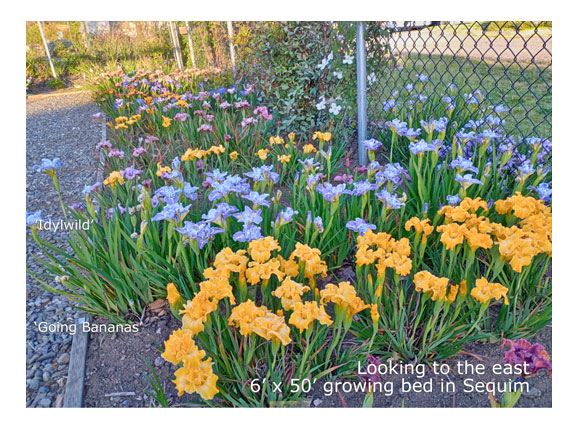
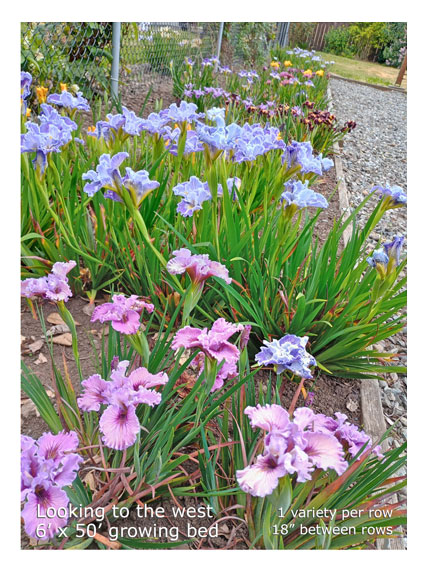
Our mother plants of irises are organized into 6-foot rows, one variety per row, that are spaced 18 inches apart in a bed that is 50 feet long.