Sequim Rare Plants, Sequim, WA 98382

Sequim Rare Plants, Plant List

Spring 2013 Plant List


We take all major credit cards. These are the plants we can send to you for the spring of 2013. There are several ways they can be ordered --
  • by printing out an order form (click here) and mailing it to us.
  • by using the secure on-line shopping cart, simply by left-clicking your mouse on the "add to cart" buttons on this page.
  • by telephoning us with your order and a credit card number, to (360) 775-1737.
Sequim Rare Plants, 500 N. Sequim Ave., Sequim, WA 98382 USA  - -  (360) 775-1737

A   B   C   D   E   F   G   H   I   J   K   L   M   N   O   P   R   S   T   V   W   Y

Achillea 'Anthea'Achillea 'Anthea'
(PP# 8,828) This yarrow has ferny, serrated, silver leaves, sulphur-yellow flowers and an upright habit. The flower stems reach a height of twenty-four inches and are great for cutting. The flowers are long lasting and useful in fresh or dry arrangements. 'Anthea' needs full sun and good drainage. She is especially valuable because she has demonstrated a stronger tolerance of rainy, humid conditions than other yarrows, while retaining her ability to withstand drought. Flowering begins in early summer and persists for many weeks. USDA Hardiness Zones 4-8. More info, click here. $5.95

Aeonium Zwartkop'Aeonium 'Zwartkop'
(usually pronounced ee-'oh-nee-um) This succulent is prized for its dark, uniquely colored leaves that in strong light will be purplish black. The leaves can be less dark and more green when dormant during winter or when grown in partial shade. It is a branching shrub that will reach three to four feet in height over several years. It is a good summer bedding plant since its architectural shape contrasts well with most other bedding plants, and can also be used effectively planted in containers. Water sparingly especially in winter, because it is adapted to dry conditions and its succulent leaves store water for use during dry periods. Because the species is native to the Canary Islands, off the coast of North Africa it cannot take much cold, although it is said to survive to 25-30°F. We can only guess at the origin of the name, "zwartkop." There is a bird, an European warbler with the common name of "blackcap," Sylvia atricapilla, that may winter in North Africa, possibly having something to do with the naming of this plant. More info, click here. $7.95

leaves of Agapanthus 'Hinag'Agapanthus 'Hinag'Agapanthus 'Hinag'
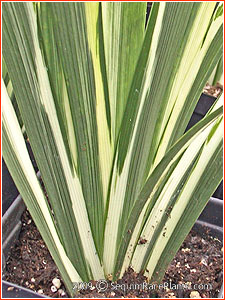
A smaller scale plant than the agapanthuses usually seen in gardens, both the leaves and flowers of this have lovely colors. The leaves are striped in creamy yellow. They are evergreen. The flowers are a light to medium blue and low at a height of twelve to eighteen inches. This lily-of-the-Nile is hardy to USDA Zone 8 (+10° to +20°F). Also known as 'Summer Gold,' 'Hinag' was introduced from Japan by Barry Yinger. Where winters are colder than Zone 8, it would make a good container plant. Its small scale is perfect for a 6-inch to 10-inch pot. More info, click here. $14.95

Agapanthus 'Northern Star'Agapanthus 'Northern Star'
Also known as lily-of-Nile, the round heads of medium blue, star-like flowers bloom profusely in July and August atop stems of 24 to 30 inches. The deciduous leaves are very distinct, having dark violet blue/black bases. One of the most cold tolerant agapanthuses, it is hardy as far north as USDA Zone 6. Click here to find your USDA hardiness zone. When cold weather arrives in fall, the leaves turn yellow and disappear until spring returns. More info, click here. $16.95

Agapanthus 'Polar Ice'Agapanthus 'Polar Ice'
The white flowers have a very light touch of violet and bloom for many weeks in July and August. The round heads of blossoms are five to six inches across on top of long green stems. They make a good cut flower. One of the hardiest of agapanthuses, it is cold hardy to USDA Zone 6. In summer it relishes frequent watering, however when dormant in winter, it needs ground that drains well to be able to survive the cold. One of the finest and hardiest of the lilies-of-the-Nile. More info, click here. $17.95

Allium sikkimenseAllium sikkimense
This low growing (6 inches) ornamental onion has sky blue flowers in summer. With its narrow leaves and low height, it is suitable for a rock garden or planted with other low growing flowers at the front edge of a bed. Once established, it is undemanding. It is also known as Allium kansuense. USDA Zones 6 - 8 in the East, Zones 6 - 9 in the West. More info, click here. $7.95

dwarf snapdragon, Antirrhinum glutinosumAntirrhinum glutinosum 'Gummy'
This low, gentle plant has gray leaves covered in hairs and sticky stems that spreads eight to fourteen inches wide and grows four to eight inches tall. It does well either planted out in the garden in spring or grown at the edge of a container garden where it will flow over the edge charmingly. As a native of Spain it can take severe heat, and will flower from the beginning of summer until frost. Flowers of light yellow to creamy white are one-inch long. USDA Zones 8 to 11. More info, click here. $5.95

Arabis 'Variegata'Arabis alpina subsp. caucasica 'Variegata'
Popularly known as rock cress, this unusual form has grayish-green leaves edged in cream that are evergreen, and can light up a garden year around. White, four-petaled half-inch wide flowers appear from early spring until the weather starts warming up (for us in the Pacific Northwest they continue on into early summer), on elongating racemes that extend above and cover the foliage. A mature plant will reach eight to twelve inches tall when flowering, however otherwise will form a low mat of spreading growth to six inches. It needs only average soil. The soil having good drainage is particularly important. For areas that have warm summers and high humidity, particularly in areas south of Zone 7, it can be short lived. Doubly colorful with its flowers and foliage, it does good duty in a rock garden, as an edging plant, and planted in the crevices of a rock wall. Native to mountains in Europe, its can survive winter cold to USDA Zone 3. More info, click here. $5.95
sorry, sold out

Asarina procumbens, trailing snapdragonAsarina procumbens
-trailing snapdragon- If you have a greenhouse you will discover that certain plants kept in pots will seed themselves into the pots of other plants or into the nooks and cranies of the greenhouse floor where they will contentedly live despite neglect. One such seeder is this plant, a relative of snapdragons from the mountains of the Pyrenees between Spain and France. This grows equally well in the garden where you will find it seeding itself about. With spreading, trailing growth, it likes filtered light as well as full sun, and flowers nonstop through summer. The round green leaves are lightly hairy. The flowers are 1½-inches long. A superb plant for a hanging basket where it will drape over the container's edge. USDA Zones 7 - 11. More info, click here. $5.95

Aster alpinus 'Goliath'Aster alpinus 'Goliath'
Aster alpinus 'Goliath' is a lively mauve form. Its flowers somehow look almost too large for the plant. With age, it covers itself in flowers. Most asters are thought of as blooming in fall. This one blooms in late spring. Being native to mountains in Europe such as the Alps, it is not a plant to grow in the South. It is better suited for cooler climates. It grows as a low clump, six to eight inches tall. Give it well drained soil in full sun or partial shade. USDA Hardiness Zones 4 - 7 in the East, Zones 4 - 8 in the West. And even farther north to Zone 3 with snow cover or other protection. More info, click here. $5.95

Aster alpinus 'Pinkie'Aster alpinus 'Pinkie'
This alpine aster, Aster alpinus 'Pinkie,' is a low growing plant that is notable for its flowering in late spring, rather than in fall as is usual for most asters. This is a selected color form with bright pink flowers with golden eyes. We propagate it vegetatively so the flowers will be uniform in color. Because its parents are native to mountains in Europe, such as the Alps, it is better suited for growing in cooler climates rather than where summers are warmer. It is especially suited for a rock garden, or planted towards the front of a flower bed. USDA Hardiness Zones 4 - 7 in the East, Zones 4 - 8 in the West. And even farther north to Zone 3 with snow cover or other protection. More info, click here. $5.95

Aster carolinianusAster carolinianus
Popularly known as the climbing aster, it has no clinging tendrils to help it grow upward, but weaves itself through other plants or through fencing and latticework. With your help tying the sideshoots up, it will grow taller more quickly. It's eventual height will be ten feet or more. The previous years growth does not die back to the ground in winter, so each year the new growth adds to its size. The leaves are small and the growth is not particularly dense, so it can happily mingle with other similarly size vines and shrubs. Our oldest plant is ten feet tall after about six or seven years growth. Being native to coastal areas of the southeastern U.S. into Florida, it needs hot summers to flower well. Its main season is October and November. In our cool climate we don't see any flowers some years. And occasionally instead of flowering in fall, the buds wait until the following spring to open! Each blossom is about an inch wide, in light pink. Large masses of them on a mature plant can be be very fragrant, something like flowering almond or marzipan, but we cannot detect any scent, there again, because of our climate. It is nicely evergreen, with the leaves taking on purple and red tints as winter arrives. Another name for it is, Ampelaster carolinianus. USDA Zones 7 - 10, possibly to Zone 6. More info, click here. $5.95

Aster 'Coombe Fishacre'Aster lateriflorus 'Coombe Fishacre'
A hardy mildew-free aster, 'Coombe Fishacre' has masses of light lilac flowers with golden eyes, the eyes turning rosy brown with age. The plant has a rounded, billowy shape. Reaching to three tall, it supports itself well without staking unless grown in more shade or in a particularly windy location. Blooms August into early October. We recommend dividing it every few years. USDA Zones 5 - 8, and to Zone 9 in the West.
For a very interesting retelling of some British garden history, including a bit about asters, click here. More info, click here. $5.95

dark leaves of Aster 'Lady in Black'creamy whilte flowers of Aster 'Lady in Black'Aster lateriflorus 'Lady in Black'
Masses of tiny cream and pink flowers will cover this plant in September and October. It grows well in full sun or a half day of sun -- full sun is required for darker foliage. The dark leaves add variety and interest to its green leafed neighbors. In rich soil it grows three to four feet tall. It will be shorter, at 2½ to 3 feet tall in average soil. This grows well in a garden that has a clay type of soil. USDA Hardiness Zones 4 -9. More info, click here. $5.95

Aster 'Andenken an Alma Pötschke'Aster nova-angliae 'Andenken an Alma Pötschke'
We offer both a delicately tinted aster, such as 'Coombe Fishacre' on our list, and a very vibrant one such as this, a vivid watermelon pink, named in honor of a husband and wife, 'Andenken an Alma Pötschke.' This aster reaches four feet tall (staking with bamboo may be necessary) and blooms from late summer into mid-autumn, making it an excellent choice for an eye-popping splash of color at season's end. Not only do butterflies love it, but it makes a good cut flower. It thrives in a wide range of conditions, doing best it full sun and an evenly moist soil. USDA Zones 3 - 8, to Zone 9 in the West. A winter mulch is recommended. More info, click here. $5.95

Aster 'Eventide'Aster novi-belgii 'Eventide'
The color of this flower is a medium lavender-blue, with golden eyes that darken as they age. New York asters are also known as Michaelmas daisies. Their season in at the end of summer into early autumn. We recommending dividing them every few years, discarding the older centers of a plant. For the greatest amount of flowers, pinching out the young tips once in mid spring, and a second time before mid-July is a good idea -- pinching them in the same way that mums are pinched to get the most flowers. Their mature height is 2 or 2½ feet. For USDA Zones 3 - 8, and to Zone 9 in the West. More info, click here. $5.95

Aster 'Tiny Tot'Aster novi-belgii 'Tiny Tot'
Aster novi-belgii 'Tiny Tot' is a very dwarf form of New York aster. Its height is half a foot, growing bushy, in a rounded bun. From late summer into October small purplish daisy-like flowers will cover the plant. The species name, novi-belgii, derives from 'New Belgium,' that was an early name for New York. USDA Zones 3 - 8, to Zone 9 in the West. More info, click here. $5.95

Aster 'Napsbury'Aster tongolensis 'Napsbury'
The growth of Aster 'Napsbury' is low and spreading. In early summer numerous, almost leafless flowering stems rise to eighteen inches. Each stem carries a large, single daisy of violet-blue with a bright golden-orange eye. The petals are thin and reflex downwards as they age. Easy to grow in average garden conditions. 'Napsbury' is a form of Aster tongolensis, a native of the Himalayas of Western China into Nepal, found on stony alpine meadows at an elevation of 11,000 feet. USDA Zones 4 - 8. More info, click here. $5.95

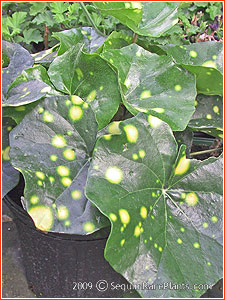
Astilboides tabularisleaves of Astilboides tabularisAstilboides tabularis
This used to be named as a Rodgersia. It needs similar care - moister ground than usual and filtered sunlight or afternoon shade. It has a different appearance, having even larger, completely rounded leaves of 2 or 3 feet wide on a full sized plant. Unusual and interesting is how the leaf stem attaches underneath to the very center of the big, round leaf, making the leaf look something like an open umbrella. Taller than the leaves are its clusters of fragrant, white flowers from summer lasting well into fall that resemble the flowers of Astilbe. The foliage will be two to three feet tall, with flower stems from three to five feet tall. Is very striking alongside a pond. Hardy in USDA Zones 5 - 9 in the West and Zones 5 - 7 in the East. Click here for an explanation of this difference between eastern and western hardiness zones on our FAQ page. More info, click here. $9.95
sorry, sold out

Aubrieta 'Red Carpet Variegated'Aubrieta deltoidea 'Red Carpet Variegated'
The flowers of this are a rich color of purplish red. The leaves are green and cream. Plant it where the drainage is good. And give it as much sun as possible. It will grow in some shade, but the best flowering will be in full sun. It does best with regular watering before and during its spring bloom. Later in the season it can take some drought. We recommend lightly shearing it as the flowering is winding down. Low growing at 2 - 4 inches tall, and spreading wider. Cold hardy to USDA Zone 3. More info, click here. $7.95
sorry, sold out

Aurinia 'Dudley Nevill Variegated'Aurinia 'Dudley Nevill Variegated'Aurinia (Alyssum)
'Dudley Nevill Variegated'

‘Dudley Nevill Variegated’ is an easy-to-grow, choice perennial that thrives in full sun and hot, exposed sites. It needs soil that is well drained and low in fertility because rich soil promotes sprawling, floppy growth. Rather than growing tall, it grows as an ever-widening mat. We recommend shearing it back lightly just after flowering. Clusters of small, bright apricot flowers cover the plant in spring. The leaves are gray-green edged in cream and are semi-evergreen, making a tapestry of color throughout the year. It is a useful plant edging the front of a garden bed, or planted in a rock garden, or for trailing over stone walls. Other plants to consider choosing for companions are campanulas (bellflowers), veronicas, alpine asters, bergenias, daffodils, and erodiums (cranesbills), among others. Hardy in USDA Zones 3 to 7 in the eastern half of the U.S. and hardy in USDA Zones 3 to 9 in the West. Click here for an explanation of this difference between eastern and western hardiness zones on our FAQ page. More info, click here. $9.95
sorry, sold out

 
A   B   C   D   E   F   G   H   I   J   K   L   M   N   O   P   R   S   T   V   W   Y top of the page - Sequim Rare Plants

richly colored leaf of Begonia 'Metallic Mist'Begonia 'Metallic Mist'
(PP# 19,567) The parents of this hybrid are Begonia taliensis and Begonia pedatifida, birthing an offspring that is surprisingly cold hardy. 'Metallic Mist' survives outdoors to USDA Zone 7B, and is possibly root hardy in favored locations to Zone 6. It is a rhizomatus begonia that resembles a rex begonia, with its large, palm-like leaves of green and silver. As it likes cool shade, the perfect spot to set it outdoors is in a woodland or on the shady, east or northeast side of a house. We recommend adding a generous amount of aged compost when planting it. The mature height will be 12 to 18 inches, with a wider spread. When grown outdoors in the Pacific Northwest, its leaves will often not sprout until June. Light pink flowers come in clusters atop stems of twelve inches. More info, click here. $7.95
sorry, sold out

hairs covering the leaves of Bergenia ciliatacreamy flowers of Bergenia ciliataBergenia ciliata
This uncommonly seen groundcover is adaptable to very dry shade and moister shade. While most bergenias are evergreen, Bergenia ciliata drops its leaves over winter. Take a closer look to note the light fuzz of soft hairs that cover the leaves and the leaf stems. The garden writer, Christopher Lloyd, described this species as quote, “beautiful,” in his book on garden foliage. We agree. Very undemanding once established. It grows well in USDA Zones 5 - 8, and also zones 9 & 10 in the West. More info, click here. $8.95

flower close-up of Bergenia c. ligulatahairs lining the leaf edgesBergenia ciliata subsp. ligulata
Little information can be found on the internet about this Bergenia. So we fall back on the 1982 edition of Graham Stuart Thomas's book, Perennial Garden Plants, or The Modern Florilegium. To quote him, “the leaves have a hairy margin and are broad and rounded ... The flowers appear early in dense heads, opening out into graceful sprays; they are nearly white but have a pretty contrast in the rosy red calyces.” He lists ligulata as a subspecies of ciliata, and they are, in truth, very much like one another in their flowers, their deciduous nature and their degree of hardiness. They are also both hairy but not to the same degree nor in precisely the same manner. Ligulata has much sparser hairs on its leaf surfaces, with more of its hairs on its leaf edges. Whereas ciliata has a much thicker blanket of hairs over its leaves and to a lesser extent, hairs on its leaf edges. The leaves of ligulata are ruffled. USDA Zones 5 - 8, and also zones 9 & 10 in the West. Limited quantity. More info, click here. $9.95

marbled leaves of Bergenia 'Tubby Andrews'Bergenia 'Tubby Andrews'
This very cold hardy perennial has evergreen leaves of green and creamy yellow in summer. When cold weather arrives in fall the coloring changes to green and various tints of pink to darker red. The colder the days become, the richer the coloring. As warm weather returns the following spring, the colors revert to creamy yellow and green on the new leaves. Occasionally a shoot with solidly green leaves shows up, that is best cut out when first noticed. Other than that, the plant demands little attention. Pink flowers show in spring, and again in fall. An ideal place to set this plant is at the edge of bushes and trees that lose their leaves in winter, or beneath them, where the bergenia will have shade during the summer, but full sun in winter. 'Tubby Andrews' also makes a good edging for a walk-way or at the front of a flower bed. He spreads slowly, in a mannerly fashion, into a wider clump over the years. USDA Zones 4 - 7 in the East, 4 - 9 in the West. More info, click here. $9.95
sorry, sold out

Buddleja colvilei 'Kewensis'Buddleja colvilei 'Kewensis'
This is large for a Buddleja, reaching a height of ten to fifteen feet, or even twenty feet where the climate is favorable. This is larger than the garden forms you most often see. It can reach the size of a small tree and grows quickly enough to do it within a short number of years. Though it cannot take much winter cold, to USDA Zones 8a to 11. In Zone 7 an established plant can regrow from the roots if its top is winter-killed. The name, 'Kewensis,' is for a plant chosen at Kew Gardens for its large clusters of pink flowers. This selection lives on by propagating it from cuttings. The flower clusters hang at the end of branch tips and are not fragrant. Its season is long -- many weeks for us in late summer. And where summers are warmer, from May to July. The green leaves are large and somewhat evergreen. Limited quantity. More info, click here. $9.95

 
A   B   C   D   E   F   G   H   I   J   K   L   M   N   O   P   R   S   T   V   W   Y top of the page - Sequim Rare Plants

gray leaves of Calceolaria arachnoideapurple baloon flowers of Calceolaria arachnoideaCalceolaria arachnoidea
The contrast between the gray, felty, spoon-shaped leaves of this plant and its round, darkly purple flowers is dramatic. Coming from from the Andes of Chile, at elevations of 10,000 ft., it can take winter cold to USDA Zone 6. In Chile it is often covered by snow in winter. However in your garden it won't survive if the ground is soggy wet in winter. In the wild it grows in various habitats from dry, rocky hillsides to moist stream banks. Consider planting it into a rock garden or combined with other flowering plants in a container garden. The flowers are on stems several inches above the foliage. The plant will be two feet tall by slightly less wide. It starts to flower in early summer and continues on to the first frosts of fall. Before the blossoms appear, a young plant looks a lot like a plant of lamb's ear, Stachys lanata. Of course this grows taller than lamb's ear and these flowers end any thought that this could be lamb's ear. More info, click here. $8.95

Calceolaria 'Kentish Hero'Calceolaria integrifolia'Kentish Hero'
This is an old variety from England with flowers that are orange and that age darker, until they become a blazing orange-red. It is developed from a plant that is native to Guatemala, and is not reliably winter hardy very far north. We list it as hardy to 20°F. It can be fickle how it survives a winter. If you plant several side by side, you may be surprised when one dies over winter while its neighbor survives. Its flowering season is very long, from late spring until fall. A plant could be dug, potted up and carried over winter indoors. The mature size will be eighteen to twenty-four inches. It produces a huge quantity of flowers in a season. If you are asking who or what is the hero in its name, it commemorates a chieftan by the name of Caratacus, who fought and beat the Romans in battle. More info, click here. $7.95

Calceolaria 'Sunshine'Calceolaria integrifolia'Sunshine'
Similar to 'Kentish Hero' in everything except flower, this plant has clusters of bright golden flowers. A plant will grow to two feet in height, and even a bit more in warmer parts of the country. It can survive winters only down to about 25°F. When grown in a container, letting it become root-bound seems to produce the greatest amount of flowers. It produces flowers for such a long season, it is a very good addition to a mixed container garden. More info, click here. $7.95

Calceolaria 'John Innes'Calceolaria 'John Innes'
Calceolaria 'John Innes' is especially suited to growing in a rock garden, although it does well beyond a rock garden when the conditions are right - partial sunlight and soil that is moist but not too soggy. This is a hybrid of species that are native to colder, very southern parts of South America, and it can take quite severe cold, to USDA Zone 5, or even colder where there is a winter's cover of snow. Its name comes from the John Innes Horticultural Institute of Surrey, England, where it originated. The plant is very low at six inches and spreads slowly wider in a compact mass. The flowers are large in size, the size of a U.S. nickel, although not round but longer, top to bottom. Each flower has its own four to nine-inch stem. The flower's color is mainly a bright yellow, with a speckling of reddish-brown spots on the pouch. It likes both good drainage at the same time as not liking to fully dry out, in other words, ground that is moisture-retentive and quickly draining. If allowed to dry out too much in summer it will go dormant early. However just because it disappears above ground, don't think that it has died. A tip: choose a location such as a slope in full sun that is well drained, and mix in an ample amount of peat moss to keep the roots moist. This little golden pouch of a flower is a special delight for a child. More info, click here. $7.95

Campanula 'Chettle Charm'Campanula persicifolia 'Chettle Charm'
Books call bellflowers of this species, “peachleaf bellflowers,” although it takes some imagination to connect its leaves to that of a peach tree. Among bellflowers, this species is distinct for its tall, thin graceful habit and large bell-shaped flowers. This particular plant has flowers of white, beautifully edged in pale lavender. The height of the flower stems will be to thirty inches. First-year plants may not produce many flowers, although you will see plenty by the second year. And they make a superlative cut flower for your home. They are the perfect length for a vase and have a long life as a cut flower. Their subtle coloring compliments most any arrangement. Cutting flowers to bring into your home will encourage the plant to keep producing more flowers. Quite cold hardy, to USDA Zone 4 (-30 to -20°F). Unfortunately it is not a plant for the deep South. More info, click here. $5.95

Campanula scheuchzeriCampanula scheuchzeri
(pronounced 'skook-zer-i) New for us, this species of bellflower grows as a low, clump of leaves with flower stems of six to ten inches. A plant will grow to twelve inches wide. The purplish blue flowers have a bell shape. It is of a height that could be used in a rock garden or towards the front of a mixed flower garden. Not particular to soil, although it would like to be kept moist through summer. And prefers full sun. As a guess, hardy to USDA Zone 4. More info, click here. $5.95

Caryopteris, commonly known as bluebeardCaryopteris 'Summer Sorbet'
The leaves of this low shrub are two or three inches long, green with broad bright yellow margins. They have a spicy scent when rubbed, and deer avoid eating them. During the later part of summer clusters of blue flowers decorate the branches. A plant grows to about three feet high and wide. It is deciduous, dropping its leaves in fall. In colder climates the tips of the branches may die back over winter, so gardeners often cut it back all the way back to the ground in spring and let it grow fresh branches. In other words, it is often treated more like a herbaceous perennial than a shrub. In August, the combination of blue flowers and golden-edged leaves is attractive. USDA Zones 6 - 8 in the East, to Zone 9 in the West. More info, click here. $9.95

Griffith's leadwort, Ceratostigma griffithiiCeratostigma griffithii
More frost hardy than you may think, established plants of this semi-evergreen, shrubby perennial will survive to 0°F. It begins to bloom towards the end of summer with sky blue flowers, and once it starts it continues on into fall. Its green leaves turn a vibrant red in fall while the plant is still blooming, giving you a glorious combination of the lighter blue against the ruddy leaves. Older plants are surprisingly drought tolerant, and survive the dryness of Western summers quite well. The mature height will be two to three feet tall by four feet wide. We sometimes cut the plant back completely to the ground at the end of winter so that the spring growth can give it a fresh look. Because it blooms on new wood, cutting it back hard at the end of winter won't keep it from flowering in its season. Anyone trying to think of good choices for late summer color should add this to their list. Late in the year when the season is waning, Ceratostigma griffithii is coming on strong. Grows well in sun or partial shade. More info, click here. $7.95

yellow flower of ChiastophyllumChiastophyllum 'Jim's Pride'Chiastophyllum oppositifolium
'Jim's Pride'

This has a tongue-twister of a name, pronounced something like, kye-as-'toff-ill-um. Other names for it are golden lambstail and Cotyledon simplicifolia. It is an evergreen perennial with succulent leaves of green and cream that have a light tinge of pink in winter. Short six-inch tall sprays of pea-like golden flowers open in late spring to early summer. It grows low to the ground and spreads modestly. A plant will send out new shoots from below ground to form a clump. Native to the Caucasus, it is cold hardy to USDA Zone 6, or Zone 5 with protection. Partial shade is usually recommended, although here in the Pacific Northwest it can take full sun. An ideal spot would be a rock garden shaded from the afternoon sun where the soil is moist but well drained. This succulent member of the crassula family doesn't grow as vigorously as its green-leafed form. If you order this please do not keep it in a pot very long, but plant it in your rock garden or elsewhere in the ground. The reason is that it can be touchy with how it's watered in a pot and can rot quickly if kept too wet. More info, click here. $7.95

Clematis tanguticaClematis tangutica
Being a native to northern China and Mongolia, this deciduous vine can happily withstand severe winter cold, to USDA Zone 3 (-40°F). A young plant will take a year to settle into a new home in your garden, though by its second year you should be prepared to jump back as it explodes into rapid growth. That second year it might not grow to a spread of twenty feet, but be forewarned it has that potential. It will climb any nearby support such as a fence, trellis or neighboring plant. Its flowers are light golden yellow and face downwards, blooming for us all summer into fall. The first flowers turn into small fluffy heads of seeds as new flowers keep appearing. If left to themselves, the seeds will blow off the vine and sow themselves around your garden. We do not think of the seedling plants as much of a problem -- they are easily spotted and removed or replanted elsewhere. A mature plant can be pruned back hard, close to ground level in winter or early spring. It quickly regrows to its full size in just a few months, and will rebloom well that year. More info, click here. $7.95

Convallaria 'Aureovariegata'variegated lily-of-the-valleyConvallaria majalis 'Aureovariegata'
Lily-of-the-valley is an attractive old fashioned ground cover for large shady areas. Small purplish "eyes" appear at ground level in early spring, that develop into eight-inch long pointed green leaves that are striped lengthwise with creamy markings. Highly fragrant bell-shaped white flowers come in spring. Orange-red berries are occasionally produced in the fall. These are poisonous. While tolerant of most soil conditions, moist soil that is rich and slightly acidic is preferred for these woodland natives. Plants multiply rapidly in favorable conditions, and should not be planted if their spreading would be a problem. An excellent plant for use as a ground cover under deciduous shade trees or for naturalizing in an open shady expanse. Occasionally a shoot with all-green leaves will appear that should be removed to keep your spreading colony well clothed in these striped leaves. More info, click here. $7.95

Convolvulus cneorumConvolvulus cneorum
This low bush, with gray leaves and the one-inch pearly white flowers with pale pink stripes on the backs is too-little-seen. It is evergreen and the leaves are downy, so the plant is drought resistant. And also long flowering, throughout summer. With a height of eighteen to twenty-four inches and slightly greater width, it is a native of Mediterranean limestone hills, and enjoys a hot sunny position in a rock garden, where fertility is fairly low and drainage is quick. Give it a once-a-year shearing as it begins to grow in spring to give it a good shape and keep it from becoming leggy. It is winter hardy in USDA Zones 8 - 11, or to Zone 7 with protection, although the top of the plant may be burned in severe winters. It is little seen though well worthy of the prestigious Award of Garden Merit (AGM) given it by the Royal Horticultural Society. In Zones colder than 7 or 8, it would make a superlative container plant, with its beautiful leaves and flowers, its long season and by reason that it likes being pot-bound better than many other plants. More info, click here. $8.95

Corydalis luteaCorydalis lutea
Growing eight to twelve inches tall, the texture of this plant is delicate with its lacey fern-like leaves and golden flowers. It is one of the longest blooming perennials in the garden. It spreads abundantly to naturalize in shady areas, however it's not much of a weed and is easily removed where it's not wanted. It seems to be more popular in Europe than here in North America. It would get my vote as one of the top ten plants for a shady garden. Hardy to USDA Zone 5. More info, click here. $5.95

 
A   B   C   D   E   F   G   H   I   J   K   L   M   N   O   P   R   S   T   V   W   Y top of the page - Sequim Rare Plants

Deinanthe 'Blue Wonder'Deinanthe's interesting leavesDeinanthe caerulea 'Blue Wonder'
Growing as a clump to eighteen inches tall, this needs partial shade and soil that will not dry out too much. It is related to hydrangeas, although it doesn't grow as a shrub but sprouts from the ground each spring with large, broad and textured leaves of green. In July and August flowers of light lavender appear at about the same height as the leaves. Its flowering season is long, with new buds opening in succession. Each flower is between an inch and two inches across and faces outwards or nods slightly downwards. It is native to woodlands in China. Hardy to −5°F. More info, click here. $9.95

Dianthus 'Bewitched'Dianthus 'Bewitched'
'Bewitched' has a large number of small flowers, so plentiful they can cover the plant is a solid sheet of color. The color is a light lavender-pink with a darker eye in the center. Its growth is compact and low. The flowers are light enough that they do not flop as do some of the larger, double dianthuses. And very well scented too. Grows well from USDA Zones 3 - 8. More info, click here. $5.95

Dianthus 'Blue Hill'Dianthus 'Blue Hill'
The dense cushion of evergreen foliage is a glaucous, bluish color, contending for the honor of having the bluest of leaves among plants. In May and June magenta-pink flowers show on five-inch stems. It shows best when grown in full sun and not crowded by taller plants. Attractive at all seasons. USDA Zones 4 - 8, and to zone 9 in the West. More info, click here. $7.95

Dianthus 'Bridal Veil'Dianthus 'Bridal Veil'
Many petals of pure white with a touch of reddish-mauve at the base create a ruffled, tousled, double flower that is an heirloom, gracing a few gardens since the 1600's. It blooms in July and August with stems of about twelve inches, adding nicely to a summer bouquet. And very fragrant. Hardy to USDA Zone 6. More info, click here. $7.95

Dianthus 'Charles Musgrave'Dianthus 'Charles Musgrave'
This variety has been around for many years. Sometimes it goes by the name of ‘Jealousy.’ It is extremely fragrant and is notable for its unusually colored eye of green. It has one fault, that it tends to be untidy, sprawling about, especially when it is in flower. So sticking in some short, branched pea sticks in spring as support when it starts to grow might be a good thought. Later in the year the support can be removed and the plant sheared back to keep it ship shape until the following spring. With fairly long stems, its flowers are good for a bouquet. USDA Zones 5 - 9. More info, click here. $9.95

Dianthus 'Dainty Dame'Dianthus 'Dainty Dame'
Petals of pristine white surround a dark red eye, with flowers the size of a twenty-five cent piece. It is very floriferous from spring into fall. And is very sweetly fragrant, this fragrance carrying some distance in the air. Its growth is tight and compact. Its leaves are are a lovely, chalky bluish-green. Grows well from USDA Zones 3 - 8. More info, click here. $7.95

Dianthus 'Gloriosa'Dianthus 'Gloriosa'
The double, frilly light pink flowers are sweetly fragrant. There is a touch of red at the center of the flowers. They bloom in July and August. The length of the flower stems is twelve to fifteen inches. Hardy in USDA Zones 5 - 8. To Zone 9 in the West. More info, click here. $7.95

Dianthus 'Laced Hero'Dianthus 'Laced Hero'
A sweetly fragrant, semi-double flower of white and reddish maroon opens in late May into June on stems of eight to twelve inches. The leaves are glaucous blue and evergreen. The key to successfully overwintering it is excellent drainage. Grows well from USDA Zones 3 - 8. More info, click here. $7.95

Dianthus 'Mrs. Sinkins'Dianthus 'Mrs. Sinkins'
This has a pure white, double flower that you will find mentioned often in books from Great Britain. It is sweetly fragrant of cinnamon/cloves. The flower stems are eight to twelve inches long and its leaves are glaucous blue and evergreen. Its flowers will flop unless supported by twigs or light “brushwork.” Grows well from USDA Zones 3 - 8. More info, click here. $7.95

Dianthus 'Old Square Eyes'closeup of Dianthus 'Old Square EyesDianthus 'Old Square Eyes'
This dates only from about 1980 when it was found as a chance seedling in a garden on the British Isles. The single flower is large at 1 to 1½ inches across, of white with a salmon-pink eye, and is sweetly scented, blooming in late spring. Each flower typically has five petals, with an eye that is a pentagon rather than square. Occasionally a flower with only four petals will open, having a eye that is precisely square. As a flower ages the salmon-pink covers more of the petals. The flower stems are just over a foot long, a good length for a vase. In the garden, supporting the flower stems with an underpinning of short, cut branches will help to elevate them for a better view. More info, click here. $7.95

Dianthus 'Queen of Sheba'Dianthus 'Queen of Sheba'
To quote Old-Fashioned Flowers, a handbook of the Brooklyn Botanic Garden, "Dianthus in all its many forms has played a seminal role in gardens for 2,000 years, at least. The most beloved is Dianthus plumarius, parent of so many 17th-century cinnamon pinks (also known as clove pinks), including 'Queen of Sheba'..." An old plant from the early 1600's, 'Queen of Sheba' has a single row of petals that have a blaze of white on the center of each petal and edged with a fringe of rose-red. The flowers are strongly and sweetly scented. More info, click here. $7.95

Dianthus 'Raspberry Swirl'Dianthus 'Raspberry Swirl'
(PP# 14377) For us this dianthus flowers much longer than the others listed here, non-stop from early summer onto fall. In warmer places a plant may rest during the middle of summer and rebloom again in fall. Young flowers open with colors of light pink and deep maroon that change as they age, with the light pink turning to pure white. Each flower lasts a very long time before fading, and is exceptionally fragrant. The plant is low with leaves of gray-green. This is a new plant bred in England. More info, click here. $7.95

Dianthus 'Sops in Wine'Dianthus 'Sops in Wine'
Intensely fragrant flowers have a single row of petals, each petal colored in deep red and white. The foliage is a glaucous blue. Flowers May into June in size of eight inches wide by eight to ten inches in height. USDA Zones 4 - 8. If you have the two volume set of books, Perennials by Roger Phillips and Martyn Rix, you will see that their photo of this plant does not match the photo shown here. In checking which plant is sold as 'Sops in Wine' in the United Kingdom, the plant offered by us is the one offered in the United Kingdom at most nurseries, for example, one being the Beth Chatto Gardens. More info, click here. $7.95

Dianthus 'Sweetheart Abbey'Dianthus 'Sweetheart Abbey'
The ruins of Dulce Cor or Sweetheart Abbey can be found today in the town of New Abbey, five miles south of Dumfries in southwest Scotland. It dates from 1273 when Lady Dervorguilla founded it in memory of her husband John Balliol (not the King of Scots, but his father, founder of Balliol College, of the University of Oxford). The monks bestowed this name upon their abbey in her honor after her death, when she was laid to rest together with her husband's embalmed heart. The fragrant flower has a full head of double petals, colored in crimson that lightens at the edges. The petals' edges are fringed with a sawtooth pattern as if cut with pinking shears. Hardy to USDA Zone 6. Needs full sun and well drained soil. More info, click here. $7.95

Dianthus 'Velvet on White'Dianthus 'Velvet on White'
Many petals of rich red and pink edged in white or a very light pink, on a compact-growing plant create the perfect flower for growing in a decorative garden container. This is what the hybridizer of this intended, growing it in pots, although we have found that it grows equally well in the ground. It is perennial and hardy to USDA Zone 6, coming through a winter in good shape. What makes it especially suitable for pot culture is its low, self-supporting height, its long season and its sweetly rich scent. Each flower would also be a good candidate as a boutonnière, for the buttonhole of a lady's or gentleman's suit jacket. More info, click here. $7.95
sorry, sold out

Dianthus 'Whatfield Ruby'Dianthus 'Whatfield Ruby'
Compact plants of six to eight inches tall by eight inches wide carry numerous flowers of rich ruby red during the months of May and June. As you would expect, the flowers are sweetly scented. The evergreen leaves are a grayish green. USDA Zones 4 - 8. More info, click here. $5.95

 
A   B   C   D   E   F   G   H   I   J   K   L   M   N   O   P   R   S   T   V   W   Y top of the page - Sequim Rare Plants

Erodium absinthoidesErodium absinthoides
Beautifully light pink flowers in clusters decorate the finely textured leaves of grayish green. Once established in a garden this plant is drought resistant. USDA Zones 6 - 9. As a side note, the sexes occur separately -- the plants we offer are all females. Native to parts of southeastern Europe and Sicily. More info, click here. $7.95

Erodium cheilanthifoliumErodium cheilanthifolium
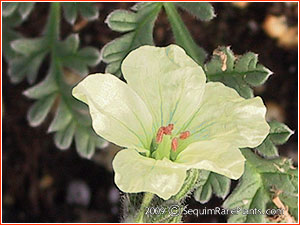
Creamy flowers have a delicate tracery of darker veins and two rich purplish blazes on the upper two petals. Long flowering and undemanding, this is a long lived perennial. Do not crowd it too closely with taller perennials, but allow it enough room to get lots of air and sunlight. It needs well drained soil to be long lived. Hardy in USDA Zones 6 - 9. More info, click here. $7.95

Erodium 'White Pearls'Erodium cheilanthifolium 'White Pearls'
'White Pearls' has white flowers and leaves that are a grayish green. It is a named clone of the species E. cheilanthefolium, that was selected at Siskiyou Rare Plant Nursery. As is true for the other erodiums, do not crowd it too closely with taller perennials, but allow it enough room to get lots of air and sunlight. It needs well drained soil to be long lived. Long flowering and undemanding. Hardy in USDA Zones 6 - 9. More info, click here. $7.95

Erodium chrysanthumErodium chrysanthum
From Greece, this yellow storksbill or heronsbill needs at least a half day of sunlight for healthy growth. In hot summer climates, it would like afternoon shade. It has light pastel yellow flowers beginning early in summer and again in fall. It flowers better in a poor, lean soil. With water conservation a growing need this is one plant that would fulfill your desire for a plant that thrives in a dry or xeric landscape. Height will be five inches with a spread of twelve inches. Hardy to USDA Zone 5. Its leaves are lacey and grayish. $7.95

Erodium 'Merstham Pink'Erodium x 'Merstham Pink'
Although many erodiums have purple blazes on their upper petals, this variety, 'Merstham Pink' is lacking the blazes and instead, the five petals are a more uniform, light magenta-pink, with dark veins running through the petals. Its leaves are grayish-green and finely divided, somewhat resembling the ferny leaves of yarrow. It grows well in full sun or a half day of sun. In full sun its foliage will be more compact and tight, and when given more shade, it grows a bit more loose and open. Its mature size is about eight inches tall and twelve inches across. When planting, adding a light dusting of dolomite lime to its planting hole will be appreciated, although not essential - if given its druthers, an alkaline soil would be its first choice. Long blooming and undemanding when grown in freely draining soil. Its blooming season is from spring to fall. Hardy to 5°F. More info, click here. $7.95

Erodium 'Natasha'Erodium x kolbianum 'Natasha'
Small in scale, this plant has lacey, feathery gray leaves and pale pink flowers with purple veins and purple blotches on the upper two petals. Its height is three or four inches, with the flowers another two or three inches above. Grows easily in the sunny, open garden, and also in a container or trough. Quickly draining soil is best for its longterm survival over winter. Hardy to USDA Zone 5. More info, click here. $8.95

Erodium 'Pickering Pink'Erodium 'Pickering Pink'
(E. 'Merstham Pink' x E. 'Katherine Joy') Lacey, ferny leaves are mostly green but can have a grayish cast. The finely detailed flowers are palest pink, with darker veins on the lower three petals, while the upper two petals have dark purple blotches overlaying pink. Hardy to USDA Zone 6. More info, click here. $7.95

Erodium trifoliumErodium trifolium
Slightly furry leaves of green that are larger than the other of the Erodiums offered by us, its thinly petaled flowers are cream with purplish-red veins and blotches on the upper two petals. Also known as Erodium pelargoniflorum, it is native to the Atlas mountains of North Africa. Will self sow in your garden. USDA Zones 6 - 9. More info, click here. $5.95

Eryngium agavifoliumEryngium agavifoliumEryngium agavifolium
The long sword-like shiny leaves, three inches wide at the base and edged with pointed teeth are evergreen. Flower stems to three feet are topped by prickly tan thimbles of flowers. Drought tolerant due to its deep roots. Its native home is the grasslands of Argentina. With age it will grow into quite a thick clump. Hardy to USDA Zone 7. More info, click here. $7.95

Eryngiums are also called sea hollies. They all have spiny, prickly leaves. The native habitat of some is at sea coasts, while others occur much farther inland. They come from both the Old World and from the Americas, with the ones from the Americas having long, sword-like leaves and the ones from the Old World with leaves that are not long and sword-like.


leaves of Eryngium carlinaeEryngium carlinaeEryngium carlinae
This seaholly is a low, mounding plant with green leaves, thinly divided into sharp spines. In summer low stems of flowers colored in steely blue rise above the leves to no more than a foot tall. It is native to Mexico, south into Central America. Its low height would make is suitable for planting in a rock garden or towards the front of a garden bed. Hardy in USDA Zones 8 - 11. More info, click here. $7.95

Eryngium variifoliumEryngium variifoliumEryngium variifolium
This sea holly has glossy green leaves with white veins. The flowerheads are more gray than blue, small at about the size of green peas and come on short stems of twelve to eighteen inches tall. What is more striking about the flowers are the very large, pointed spines surrounding the base of the flowers. They are colored silvery gray. Their attractive leaves are evergreen. A plant will grow into a slowly widening clump over several years. Like the other sea hollies listed here, it develops a thick taproot. Hardy in USDA Zones 5 - 9. More info, click here. $7.95

Eryngium yuccifoliumEryngium yuccifolium
Here is an upright, architectural plant that is native to a large area of the United States - from New Jersey south to Florida, west to Texas, north to Minnesota and eastwards back to New Jersey. Quite a range. Despite being a native, it has an exotic appearance, resembling something from the desert Southwest, such as a yucca that its species name, yuccifolium, refers to. It has a very tough consitution, withstanding drought and less than ideal garden conditions. The plant's leaves grow to eighteen inches tall, with flowers coming in late summer on stems of four to five feet. The flowers are round, creamy buttons, in thistle-like clusters. Earlier Americans thought its roots could cure the venom from a snake bite, and gave this plant the name of “rattlesnake master.” (This plant, most definitely, does not attract snakes.) In a garden, its upright growth makes a nice accent. Not easy to find at nurseries or garden centers. USDA Zones 4 - 9. More info, click here. $7.95

 
A   B   C   D   E   F   G   H   I   J   K   L   M   N   O   P   R   S   T   V   W   Y top of the page - Sequim Rare Plants

Farfugium japonica 'Argentea'dramatic coloring of Farfugium 'Argentea'Farfugium japonica 'Argentea' a.k.a. 'Albovariegatum'
This grows one or two feet tall, and even to three feet with ideal conditions in shade. The round leaves are ten inches across, green with white creamy margins,and sometimes with a touch of pink.The leaves and stems can be lightly covered with downy fuzz, that rubs off when touched. Yellow daisy-like flowers show at the end of summer often no taller than the leaves. Cold hardy to USDA Zones 7 - 11. A plant will often wilt on hot sunny days if it is planted in full sun. This is not a sign of dryness of the roots in most cases, so don't water a wilted Farfugium if it is just flagging due to the heat. Some plants to grow with it are primroses, irises that like shade such as Iris foetidissima and I. japonica (listed on this website), and astilbes and hostas. Thinning out its large leaves on occasion is a good idea, especially so it doesn't crowd its neighbors. Farfugium resembles a different large-leafed plant, Ligularia, and can be mistaken for it. Although their appearances are similar, they like different growing conditions, Ligularia needing moisture and Farfugium liking ground that is well drained. More info, click here. $10.95

Farfugium 'Cristata'Farfugium 'Cristata'Farfugium japonica'Cristata'
The large leaves grow to ten inches wide and have highly ruffled edges. Their coloring is unusual, velvety gray-green with new growth in spring having rosy-pink highlights. Our plants are propagated by dividing highly ruffled mother plants. Blossoms in late summer and fall with yellow flowers. Mature size is two feet tall by two feet wide. A plant will grow into a thick clump. Afternoon shade is recommended. USDA Zones 7 - 11. Where winters are colder, easily grown in containers and wintered in a cool greenhouse. Keep evenly moist. More info, click here. $9.95

flower of Fuchsia procumbensfruit of Fuchsia procumbensFuchsia procumbens 'Variegated'Fuchsia procumbens
'Variegated'

This is a very curious little plant, a low growing and prostrate shrub from New Zealand, that doesn't look much like a typical fuschia. The leaves are small, rounded and irregularly mixed with cream, pink and green. The flowers are upright, not drooping as is usually seen, and are colored amazingly in yellow and purplish-red, with blue pollen. Established roots are hardy to 10°F. Plants that are frozen above ground may regrow from underground if the plant has established itself over several years. Flowers from June to October. The photo shown here of the red fruit was taken in early January in a greenhouse, when the plant drops some of its leaves and is resting. This fuchsia can be planted singly in its own pot or mixed with other plants in a large container, in either case it will trail over the edge. Planted in the ground inside a greenhouse I have seen it grow large, several feet in every direction, and clambering up and through its neighbors. More info, click here. $7.95

Fuchsia 'Elizabeth Hobby Variegated'Fuchsia 'Elizabeth Hobby Variegated'
A small leaved upright fuchsia with tiny pink flowers, this has leaves of green and white. In a window that receives morning light it would be happy in a small pot on the window sill. In summer it can be moved outdoors. It would also be a nice addition to a mixed container of flowering plants. Other good companions for this would be felicia, chaenorrhinum, convolvulus, lobelia, silene and carex as just a few of the possibilities. Cold hardy to USDA Zones 9 and 10, and possibly Zone 8 with protection. More info, click here. $7.95

 
A   B   C   D   E   F   G   H   I   J   K   L   M   N   O   P   R   S   T   V   W   Y top of the page - Sequim Rare Plants

Gift Certificate
Gift certificates can be sent in any amount, and for any occasion. For information about ordering a gift certificate, please click here.
 

a fragrant GladiolusGladiolus tristis
We have a special fondness for fragrant plants, and this being fragrant, it is a favorite. However, we would like to stress that our plants of it are being offered for growing in containers rather than for growing in the ground outdoors. By growing in pots, it can be grown in a much greater part of the U.S. than is possible otherwise. And in mild climates such as in California, growing it in pots reduces the concerns of it spreading to become a weed.
   A fragrant gladiolus! The spring flowers of this gladiolus will be open during the day but only become scented late in the afternoon, with the sweet fragrance continuing through the night. It is pollinated in its home of South Africa by a moth that is attracted by the scent. A nickname for Gladiolus tristis is the marsh Africaner, which hints at its liking wet ground. The leaves are grasslike - eighteen inches long and very thin. The flowers are a light milky yellow, infrequently brushed in tan, and about two inches wide.
   Said to survive in the ground outdoors to +10°F, our preference is to grow clumps of this in pots that are stored over winter by the window of an unheated porch, garage or basement. Or, as we do, in a cool greenhouse where the nighttime temperature drops close to freezing. It is normal for its new leaves to sprout in fall and carry over winter, followed by an early spring blooming. As summer arrives the blooming ends and the leaves wither and disappear during the summer months, when its soil needs to be dry.
   So when grown in a container, at the end of summer the potted plant will be dry and dormant. Starting in October, begin watering the pot's soil lightly, not enough to thoroughly soak the entire container but enough to let the plant know that water is available if needed. When new leaves first sprout, continue to water only lightly, although once the leaves grow more than a couple of inches tall, more frequent water can be given. The potted plants we offer will have several plants per pot.
   Our plants were purchased as a true species yet are possibly a hybrid, as they cross-pollinate easily. More info, click here. $5.95

 
A   B   C   D   E   F   G   H   I   J   K   L   M   N   O   P   R   S   T   V   W   Y top of the page - Sequim Rare Plants

flower of Hebe 'Tricolor'Hebe 'Tricolor'Hebe speciosa 'Tricolor'
Hardy to USDA Zones 9 and 10, for us this tender shrub needs protection during the winter. It may survive outside in the ground in most winters, however during our severest winters may die, so we prefer to grow it with other attractive plants in a mixed planter, that can be brought into a garage or porch over winter. Small 3-inch clusters of violet-purple flowers come in summer. Its creamy, green and pink-to-purple lustrous foliage is the main attraction. Can grow two to three feet tall and as wide, but looks very nice also as a smaller plant. Another name for this is 'Purple Tips.' Give it a once a year shaping during the growing season. More info, click here. $7.95

very dwarf ivy, 'Spetchley'Hedera helix 'Spetchley'
This ivy has extremely teeny, tiny leaves. The leaves are three-lobed and solid green. There is a thirty acre estate on the British Isles named Spetchley Park, three miles from Worcester, where it likely originated in 1962, although I do not know the details. Winter hardy to USDA Zone 5. More info, click here. $6.95
sorry, sold out

Helleborus 'Janet Starnes'Helleborus 'Janet Starnes'
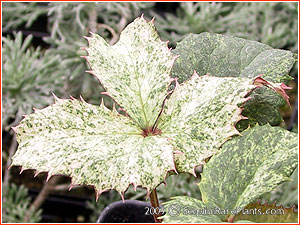
Named by Phillip Curtis Farms (a wholesale nursery no longer in business) for plantswoman Janet Starnes of Molalla, Oregon, who found the original in a batch of seedlings. To quote their 1999 wholesale catalog, "shining blue-green leaves are dusted with galaxies of white and dark green stars. New leaves, almost cream colored, are fringed with pink; older leaves darken to a marbled green. Clouds of soft green flowers in early sping. Named for the Janet Starnes." Blooms on the previous year's growth. The flowers are showy, but the main attraction is the unusual foliage. Some gardeners cut off the flowers at the ground in early spring to allow a better view of the creamy colored new growth. Cold hardy to -10°F. More info, click here. $9.95

sweetly scented Hemerocallis citrinaHemerocallis citrina
What is so special about species daylilies? Their simple forms and lines cannot be improved upon no matter how hard hybridists try, coming up with ruffles and doubles. Their simple forms are also classic forms. To that add the wonderful scent that this species, Hemerocallis citrina, carries in her light yellow flowers, and you have a daylily that need never be discarded for the newest, latest hybrid. More info, click here. $10.95
sorry, sold out

Hemerocallis vespertinafragrant Hemerocallis vespertinaHemerocallis citrina var. vespertina
With a pleasing scent and a lovely light yellow color, with darker reverse to the petals, here is a daylily to cherish. Flowering stems are tall at three to four feet. The season for Hemerocallis citrina var. vespertina is mid summer. Flowers are open during the day and last well into night. More info, click here. $10.95

Hemerocallis exaltataHemerocallis exaltata
Rarely offered, this species, Hemerocallis exaltata, is very robust, so strong that a gardener would think that it is on steroids, much like a tetraploid daylily. The flower stems are thick and reach to four and five feet.The flower is a very nice apricot color, and it flowers in the middle of summer. More info, click here. $12.95

Hemerocallis fulva 'Kwanso Variegata'variegated, double flowered daylilyHemerocallis fulva 'Kwanso Variegata'
(variegated, double-flowered daylily) This plant, Hemerocallis fulva 'Kwanso Variegata,' is named following the guidance of the book, The Daylily: A Guide for Gardeners, by John P. Peat and Ted L. Petit. Having double flowers of orange, once it reaches flowering size a plant will spread quickly by underground shoots, so it requires effort to keep it within bounds. And it has been criticized for sometimes having sideshoots that are all-green. We notice this with our plants, and discard any all-green sideshoots when they first show in spring. In any case the plants we send will have striped leaves, so you will be off to a good start ! Cold hardy to -35°F. More info, click here. $12.95

variegated Hemerocallis 'Golden Zebra'dwarf Hemerocallis 'Golden ZebraHemerocallis 'Golden Zebra'
(PP 14,221) A medium sized daylily with flowers that reach only 15 to 24 inches in height, this daylily has 3-inch golden flowers in July and August. Even if it never flowered this would be worth growing for its colorful leaves. They start out green and creamy yellow, turning to a richer yellow and green with time. The variegation in this plants is stable, so you will not see any growth with solid green leaves. Cold hardy to USDA Zones 5 - 11. Where summers are especially hot, placing it in your garden where there is partial shade in the afternoon is recommended. More info, click here. $12.95
sorry, sold out

Hemerocallis lilio-asphodelusHemerocallis lilio-asphodelus
One of the earliest daylilies to flower each spring, in May, this species, Hemerocallis lilio-asphodelus, grows into thick clumps and spreads moderately by sending out stems underground, a foot or two. Very nicely scented are the light lemon yellow flowers. The height of the flower stems is two and a half feet. As with other daylilies, demands little if any care, and is long lived. Another name for it is, Hemerocallis flava. More info, click here. $10.95

petite Hemerocallis 'Little Minor'Hemerocallis 'Little Minor'
The nursery who sold us our first plant of this petite daylily in 1992, Montrose Nursery in Hillsborough, North Carolina, is no longer offering plants by mail-order. It is one of several fine nurseries from the 1980's and 90's that we happily remember and miss. To quote their catalog, “we are delighted to be able to offer this charming daylily. It is an old cultivar, small enough to be suitable for a rock garden with scapes only 1' or less. It blooms very early in mid-spring and then again in the fall with yellow, fragrant flowers.” USDA Zones 3 - 10. More info, click here. $10.95

Herniaria 'Sea Foam'Herniaria glabra 'Sea Foam'
(PP# 15,989) This evergreen groundcover, with a common name of variegated rupturewort, is a recent introduction and not yet widely grown. At first glance it looks to be a variegated thyme, with its tiny green leaves edged in cream, and with a low, creeping habit. But it is more adaptable than thyme, growing in full sun or partial shade, and growing farther south. A very undemanding plant, its rate of spread is not too fast. And because it is so low, it is an excellent choice for a groundcover in a variety of situations. Hardy as far north as USDA Zone 4b, it also grows well in the South. More info, click here. $5.95

 
A   B   C   D   E   F   G   H   I   J   K   L   M   N   O   P   R   S   T   V   W   Y top of the page - Sequim Rare Plants

Iris ensata 'Exuberant Chanty'Iris ensata 'Exuberant Chanty'
Three petals in a rich mid violet-blue is the color. This has an extended season of flowering as a flower stem will produce additional buds, and also a plant will send up flower stalks later in the season, after the primary Japanese iris season has passed. USDA Zones 5 - 10. More info, click here. $9.95
sorry, sold out

Iris ensata 'Norma'Iris ensata 'Norma'
'Norma' has six falls of light pink. She grows very strongly. Flowering season is June into July. Her height will be two and a half feet. USDA Zonrs 5 -10. More info, click here. $9.95
sorry, sold out

striped leaves of this iris are cream and greenIris foetidissima 'Variegated'Iris foetidissima 'Variegated'
Prefering shade over sun, the dark green leaves irregularly striped in creamy white will turn yellow if planted in too much light. They reach a height of eighteen inches. Flowering is infrequent on this variegated plant, the flowers being pale lilac and amber. The non-variegated form of this flowers more prodigously. When it does flower, they turn into large seed pods that open to reveal bright orange berries at the end of summer. The colorful leaves are reason enough to grow this, for they are evergreen and decorate the garden much longer than the flowers and seedpods. In gardens where winter temperatures drop into the teens Fahrenheit, the leaves may be damaged and need to be cut back in late winter. Cold hardy to USDA Zone 7. More info, click here. $9.95
sorry, sold out

Iris gramineaIris graminea
In May small reddish purple flowers nestle among the dark green, arching leaves. At close hand they are scented of plums or apricots, not strongly, but lightly. Interesting seed pods follow in fall that have narrow, slightly winged ridges. This iris grows well in average soil. It prefers partial shade. Twelve to sixteen inches tall. Cold hardy to USDA Zone 5. More info, click here. $7.95

Iris japonica 'Aphrodite' flower of Iris japonica 'Aphrodite'Iris japonica 'Aphrodite'
From Japan, this woodland iris needs shade. Pale blue flowers, several to a stem open in spring. They are fringed and there are spots of orange and yellow dotted at the base of the falls. They are an inch to an inch and a half across and have something of an exotic look to them, a bit orchid-like. Plants will spread moderately by thin rhizomes. The leaves are equally streaked in green and cream. Height of the plant is ten to twelve inches. Hardy in USDA Zones 7-9, although it can grow as cold as Zone 5 in a protected location. It has been planted to good effect as a groundcover in some of the large greenhouses and conservatories of botanical and municipal gardens. More info, click here. $7.95

Iris lazicaIris lazica
The flowers of this iris are a light to medium lilac, and bloom from late winter to early spring on stems about eight inches tall. Their appearance closely resembles the flowers of the other winter-blooming iris we grow, Iris unguicularis. However the evergreen leaves of this are broader than the other's, so much wider that when they are out of flower the two irises cannot be confused, one with the other. Iris lazica is not the easiest iris to grow for much of North America as it does best where winters are not too cold, such as parts of the South and along the Pacific Coast. Some sources say it prefers partial shade to growing in full sun, while other sources who have seen it growing in the wild, report it to grow both in full sun and in filtered light. Ours are grown in full sun, with leaves reaching to about a foot tall -- when grown in shade, the leaves will likely be taller. USDA Zones 7 and 8, and Zones 9 and 10 along the West Coast. More info, click here. $9.95

Iris 'Bay Street'Iris (Pacific Coast) 'Bay Street'
'Bay Street' has flowers combining purple and cream in equal measure, with dark purple veins on creamy white falls. It grows vigorously, and is a hybrid of Joseph Ghio, proprietor of Bay View Gardens. More info, click here. $8.95

The next few irises on this list are hybrids of plants that are native to the coast of North America along the Pacific Ocean, known as “Pacific Coast hybrids,” or as “pacifica hybrids”. They thrive where winters are mild. So they are not a good choice for gardeners everywhere. But for the West Coast where summers are bone-dry, they are excellent irises to have. And we need more plants that are content with dry summers. They bloom in April into May at a height of about 8 inches. Near the ocean they can take full sun but away from the coast filtered shade is recommended. The plants we offer are potted and can be planted in spring or in fall. Hardy to 0°F.


Iris 'Fireflow'Iris (Pacific Coast) 'Fireflow'
'Fireflow' has ruffled flowers of a very dark blood red surrounding a golden center. The petals are partially edged in a thin line of gold. More info, click here. $8.95
sorry, sold out

Iris 'Idyllwild'Iris (Pacific Coast) 'Idyllwild'
'Idyllwild' combines falls of medium lavender-blue with a very ruffly center buff of lighter sepals and standards. The lavender-blue petals are colored lighter at their edges, and have a creamy center line. More info, click here. $8.95

Iris 'Ocean Blue'Iris (Pacific Coast) 'Ocean Blue'
'Ocean Blue' is mostly a light lavender-blue, close to a sky-blue. Darker veins run through the petals, and each petal has a golden blaze at its base. More info, click here. $8.95

Iris 'Sierra Azul'Iris (Pacific Coast) 'Sierra Azul'
'Sierra Azul' has creamy white flowers with just a hint of very light blue towards the edge of the petals. This delicate blue can be fleeting. The petals' edges are nicely ruffled. More info, click here. $8.95

Iris 'Silver Moon'Iris (Pacific Coast) 'Silver Moon'
'Silver Moon' has ruffly flowers of cream to a very delicate lilac, blushed a bit darker towards the inner part of the petals. More info, click here. $8.95

Iris sibirica 'Baby Sister'Iris sibirica 'Baby Sister'
The growth of a Siberian iris is typically very dense. Within two or three years it will have grown into a thick clump, and so thickly, that weeds have difficulty growing within the expanding clump. A young plant of this variety, 'Baby Sister,' when first planted in a garden will be taller, at twelve to fourteen inches, than it will be later on when the clump becomes crowded. Later on, the flowers will top out at eight to ten inches. The three-petaled flowers are a medium purplish blue, with darker veins and with a white blaze at the base of each petal. Its season is May into early June. Be sure to plant this deeply enough so that the top of the roots are slightly below the soil surface, and not planted as high as you would a bearded iris. It appreciates being watered regularly throughout the summer, although older plants can take some drought. An oldtime saying for growing a Siberian iris is that, “it likes its toes damp, but its ankles dry.” So its preference is for slightly damp soil. 'Baby Sister' mixes well with other flowers in either full sun or a half day of sun, and it provides rich color in flower and attractive foliage after flowering. Very nice when planted along a stream or pond. And very cold hardy, for USDA Zones 2 - 9. More info, click here. $7.95

Iris unguicularis 'Alba'closeup of Iris unguicularis 'Alba'Iris unguicularis 'Alba'
Golden centers contrast to the pristine white petals on this evergreen iris that likes growing in full sunlight. The height of the plant's leaves will be twelve to fifteen inches, with the flowers being just a bit lower. To allow a better view of the flowers we sometimes cut back the leaves in late autumn. Has a long season of bloom during winter, opening flowers during mild weather. Also grows happily in a pot, either of plastic or terra cotta, flowering better as it becomes pot-bound. Limited quantity - limit of one per order, please. USDA Zones 7 - 10. More info, click here. $14.95
sorry, sold out

Iris unguicularis 'Mary Barnard'Iris unguicularis 'Mary Barnard'Iris unguicularis 'Mary Barnard'
A dark purple is the color of 'Mary Barnard.' The petals are not as wide as other varieties of this winter-blooming plant. Flowers freely after her first couple of years in a new location. The only problem it ever has is slugs and snails eating the flowers. USDA Zones 7 - 9, and to Zone 10 in the West. More info, click here. $9.95

Iris unguicularis 'Walter Butt'Iris unguicularis 'Walter Butt'Iris unguicularis 'Walter Butt'
Another, older name for this species is, Iris stylosa. It is native to North Africa and the Eastern Mediterranean. This variety, 'Walter Butt,' has wide petals of very pale, pinkish lavender. You will read that this winter-flowering iris needs dry ground and lots of warmth. It does grow well in these condtitions, once it has gained some size, although in my experience dry ground and lots of warmth are not necessary. Our climate here on the coast is very cool and this iris does well. The ground where it is placed is not dry, but instead is well-nourished and moist. What seems essential is having enough patience to allow it two or three years to grow thickly enough, before expecting much flowering. For the first few years after planting you may doubt that it can flower for many months. It can and will for you in its own sweet time. An older clump starts to flower in November and continues through winter into early spring. A clump that is a foot or more wide, can produce dozens of flowers in a season. Digging it up to see what's causing all of the flowers, you would see a conjested tangle of branching, inter-locking rhizomes. Allowing the roots to grow this way and not constantly replanting it insures the greatest amount of flowers. A plant will stop flowering in the middle of winter when the temperature drops to +15°F, and resumes flowering when the temperature rises. Hardy to USDA Zones 7 to 9, and to Zone 10 in the West. Some gardeners have it survive into Zone 6. More info, click here. $9.95

 
A   B   C   D   E   F   G   H   I   J   K   L   M   N   O   P   R   S   T   V   W   Y top of the page - Sequim Rare Plants

winter flowers of Jasminum nudiflorumJasminum nudiflorum
With long slender, pliable stems that can reach to twelve feet or more, it grows well as either a vine or as a bush. It doesn't grow upwards as a vine without the help of tying it to a support or weaving it through the support. When grown as a bush it also needs some support when young. Unlike most jasmines, its yellow flowers are not scented. Despite this it is an unusually ornamental plant because it blooms for so many months of winter into spring. A large plant of this jasmine resembles forsythia. However it is much better than forsythia for its graceful habit, and earlier and longer bloom. Popularly known as winter jasmine, it is cold hardy in USDA Zones 6 - 9. More info, click here. $7.95

 
A   B   C   D   E   F   G   H   I   J   K   L   M   N   O   P   R   S   T   V   W   Y top of the page - Sequim Rare Plants

Kniphofia 'Apricot'Kniphofia 'Apricot'
There are several Kniphofias with flowers colored in apricot. This flowers in June into July with soft, apricot-yellow flowers atop 2½-ft stems. The flowers are a warm, subtle color. USDA Zones 7 - 9.
   Joy Creek Nursery also offers a Kniphofia that's named, 'Apricot.' However it is not the same as this one. Theirs flowers a bit later in summer, and does not match the coloring of this. The one we are offering was purchased from Canyon Creek Nursery a dozen years ago. More info, click here. $14.95
sorry, sold out

Kniphofia 'Apricot Soufflé'Kniphofia 'Apricot Soufflé'
Flowering in July, this softly colored orange/apricot and creamy yellow flower reaches a height of two and a half feet. The soft and rich colors of 'Apricot Soufflé' mix beautifully with lavender, blue and white flowers. More info, click here. $9.95

Kniphofia 'Bee's Sunset'Kniphofia 'Bee's Sunset'
It flowers in midsummer. The flowerheads are shaded a yellow to subtle orange. Reaches a height of three feet. You might dispute this height the first year after you plant it -- it may grow taller for you. As a general rule with many kniphofias, they oftentimes have taller flower spikes their first year, in part, possibly due to rapidly growing in rich, freshly prepared ground. USDA Zones 6 (with winter protection) to 10. More info, click here. $8.95

Kniphofia 'Bleached Blonde'Kniphofia 'Bleached Blonde'
Flowering height is three to four feet in early summer. The flowers are cream colored shading at the top of the flowerhead to light tan or auburn. Reblooms reliably at summer's end, with a change of color, having green in the flower. USDA Zones 6 - 9. More info, click here. $8.95

Kniphofia 'Bressingham Sunbeam'closeup of Kniphofia 'Bressingham Sunbeam'Kniphofia 'Bressingham Sunbeam'
'Bressingham Sunbeam' is one of our less popular kniphofias, possibly because its flowers are neither a light and delicate color, nor a bright and flashy hue. However, I can understand why Alan and Adrian Bloom of their famous nursery in England chose this flower. Its colors are an unusual amber yellow, lightly brushed in a reddish-tan. The height is lower than the average kniphofia, at about two feet. It blooms in July and August. More info, click here. $9.95

Kniphofia 'Candlelight'closeup of Kniphofia 'Candlelight'Kniphofia 'Candlelight
Lemon yellow flowers on three to four-foot stems in June with more flowers appearing towards fall. There are two different kniphofias with this name. We have both. The one illustrated here was named by Bloom's of Bressingham long before the second one appeared. The second is more recently introduced from a nursery in Georgia, and was given a plant patent, believe it or not ! They are nothing like one another. The second is not this lemon color, but is more ivory colored and is shorter. It is a good plant, but why was it allowed to be given this name ? There is more than a little confusion with the naming of these plants. USDA Zones 6 - 10. More info, click here. $10.95

flower of Kniphofia caulescensKniphofia caulescens
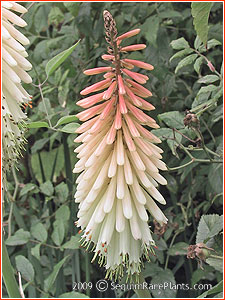
Kniphofia caulescens is a unique red-hot poker that is native to higher elevations in Lesotho (pronounced li-'soo-too), a small country in southern Africa. Because it is native to higher elevations it survives a fair degree of winter chill. Several online websites claim it to be hardy to USDA Zone 5. In just the right location it may, however Zone 6 is a safer bet. Be sure to plant it where the soil drains well. Its species name, caulescens, refers to the stems branching above ground. Its mature height will be 18 to 24 inches, with flowers 24 inches above that. The flowers are a coral-red above and a creamy light yellow below. For us they bloom in late summer. In warmer places they bloom from mid to late summer. The leaves tend to be evergreen, even though freezing weather will burn back the leaf tips. The leaves are a striking bluish, glaucous green. The flowers are pollinated by birds in its native home. Birds, particularly hummingbirds and a few songbirds, visit its flowers in our gardens, drinking the nectar. USDA Zones 6 - 8 in the East, to Zone 10 in the West. More info, click here. $10.95

Kniphofia 'Christmas Cheer'Kniphofia 'Christmas Cheer'
'Christmas Cheer' has been growing here outdoors without any protection for twenty years, surviving winter temperatures down to +6°F. And to repeat, 'Christmas Cheer' received no covering or other protection during these twenty years. So it survives temperatures well below freezing quite well. However, the flowers cannot take a frost, and because they bloom during December, January and February there is no practical reason to grow this red-hot poker unless you live where winters are very mild or if you have it potted over winter in a greenhouse. Of course winter weather varies from year to year, and some winters we get a mild spell when the flowers bloom well outdoors. The photo of 'Christmas Cheer' shown here was taken in our greenhouse during January of 2011. So, the bottom line is that it is best in a warmer climate such as the Deep South or Southern California. It is one of the brightest plants, even brighter in life than in our photos. It is a hot orange-red, with older flowers turning to light yellow. Height will be 2 to 3 feet. Limited quantity. More info, click here. $14.95
sorry, sold out

Kniphofia 'Cool Knip'Kniphofia 'Cool Knip'
The proprietor of Seedhunt, Ginny Hunt, graciously provided several plants of 'Cool Knip' to us a few years back, a plant that she selected and named. Click here to visit Seedhunt's website, offering seeds of California wildflowers by mail-order. 'Cool Knip' is similar in coloring to the torch lily named 'Ice Queen' which has large creamy white and greenish flowers. And though 'Ice Queen is large, 'Cool Knip' is even larger and taller. Height of 3 to 4+ feet. 'Cool Knip's' flowering season is in summer in most climates, although it blooms for us in fall because of our cooler, maritime climate. It does not grow into a thick clump of shoots nearly as readily as most Kniphofias. So although we have been growing it since 2009 we have only a few plants to offer. And will be limited to one per customer, please. This plant survives well to USDA Zone 6, as reported by Seneca Hill Perennials, located in Oswego, New York. More info, click here. $19.95
sorry, sold out

Kniphofia 'Coral'Kniphofia 'Coral'
Blooming in early summer, the coral colored flowerheads reach a height of three to four feet. Given to us generously by Deborah Whigham and Gary Ratway of Digging Dog Nursery some years ago. Very robust and surviving a greater degree of cold, to USDA Zone 5. More info, click here. $9.95
sorry, sold out

Kniphofia 'Corallina'closeup of Kniphofia 'Corallina'Kniphofia 'Coralina'
Bi-colored in an orange-red and creamy yellow. The flowers open in June and July, on two and a half to three foot stems. 'Corallina' grows strongly. USDA Zones 6 - 10, possibly to Zone 5 with protection over winter. More info, click here. $6.95
sorry, sold out

Kniphofia 'David'Kniphofia 'David'
This British variety is not new -- we were given it by a Kiwi friend (from New Zealand) about twenty years ago. But it is not readily available either in the British Isles or in America. This year of 2013 we seem to be the only online source for it anywhere, and likely to be the only US nursery currently growing it. British gardening books describe it as being a short plant with flowers resembling another British variety named, 'Atlanta.' In other words, reddish above and light yellow below. For us, 'David' is low, with a height of 24 inches. Its flowering season is the middle of summer. Smaller scale and tidy foliage. USDA Zones 6 - 9. More info, click here. $14.95

Kniphofia 'Earliest of All'Kniphofia 'Earliest of All'
This is a lovely, solidly reddish flower whose season is early summer. The flowers reach a height of 2½ - 3½ feet. For a red-hot poker, it is especially winter hardy, surviving to USDA Zone 5. And it grows vigorously. It may rebloom closer to fall if watered regularly through the latter weeks of summer. More info, click here. $6.95
sorry, sold out

Kniphofia 'Gladness'Kniphofia 'Gladness'
Orange-golden flowers that are darker at the top of the flowerhead and lighter on older, lower flowers. The flowers are on 3-foot stems from the middle of summer through August. Our local birdlife loves to visit these flowers and drink nectar from them. They produce so much that you can taste it yourself if you are not shy about bending down to lightly attach your mouth to a flowerhead and lightly sucking from several of the older, open florets at once. And don't be surprised if there is so much nectar that some drips down your chin. USDA Zones 6 - 9, and to zone 10 in the West. More info, click here. $8.95

Kniphofia 'Glow'Kniphofia 'Glow'Kniphofia 'Glow'
Flowers of a solid coral red in mid summer on stems of two to three feet. The photo on the left shows it backlit with the late afternoon sun, glowing with the appropriate conditions. In the photograph on the right, there are two spikes of 'Glow,' the one on the left being younger. Within a couple of days it will look exactly like the flower-spike on the right. To help this settle into a new home, winter protection is recommended for its first winter. It will rebloom in fall. Another name for this is 'Coral Glow.' USDA Zones 6 - 10. More info, click here. $10.95

dwarf golden Kniphofia 'Goldelse'closeup of golden Kniphofia 'Goldelse'Kniphofia 'Gold Else'
Also spelled, 'Goldelse.' With a low height of two or two and a half feet, this is an old variety dating from 1908 that according to British Kniphofia authority, Jane Taylor, is a primary hybrid between the two species, pauciflora and citrina. The color is a light yellow. For us it flowers in early summer. Another similarly low and yellow torchlily, 'Brimstone,' flowers here at the end of summer. USDA Zones 6 - 10. More info, click here. $10.95
sorry, sold out

Kniphofia 'Goldmine'Kniphofia 'Goldmine'
In July and August come these golden flowers saturated in a cinnamon amber, in a warmly burnished, sunny hue. Their height is two and half feet to three and a half feet. USDA Zones 6 - 9, and to zone 10 in the West. Our plants are propagated by dividing them, that guarantees the offspring are the color they should be even though many fewer can be produced than if they were grown from seeds. Our original stock of this came from Carroll Gardens in Westminster, Maryland. More info, click here. $14.95

Kniphofia 'Green Jade'Kniphofia 'Green Jade'
This famous plant flowers towards the end of summer with a height of three to four feet, in a color of lime green. Americans have read about it in British gardening magazines for years and have only recently been able to find it on our side of the pond. Its colors are not so unique that not having it should have driven us so mad. But there can be magic in a name. If Beth Chatto was the person who chose this name for her plant, she missed her calling and could have made a career in advertising. USDA Zones 6 - 10. More info, click here. $13.95

Kniphofia 'Ice Queen'lime green Kniphofia 'Ice Queen'Kniphofia 'Ice Queen'
One of my favorites, the large white torches are lime green when first opening, on stems of three feet, showing for us in late summer into fall. It may flower earlier in the summer for you because many of the late-summer torchlilies will often flower earlier where summers are warm. Although large sized, it grows more slowly than others. In late summer and fall when there are so many warm colors, this cool white and lime is arresting. With this torchlily, its flower stems may grow taller than three feet the first year or two after planting, especially if you plant it in rich soil. After a plant becomes well established in a year or two its flower stems will settle into a height of three feet. USDA Zones 6 - 10. More info, click here. $13.95

Kniphofia 'Lemon Queen'Kniphofia 'Lemon Queen'
To quote Jane Taylor in “The Plantsman,” “...an old cultivar, mentioned as long ago as 1902 (The Garden); a seedling of K. citrina producing in August dense spikes of lemon yellow flowers, green-tinted at first, fading to silver; 90cm (36 in.). It received an Award of Merit at the Wisley trials in 1929, and is I believe still in cultivation.” It flowers here in coastal Washington State in June and July and its colors are a pure lemon yellow. It is extraordinarily strong growing. USDA Zones 6 - 10, and Zone 5 with protection over winter. More info, click here. $8.95

Kniphofia 'Lightning Bug'Kniphofia 'Lightning Bug'
The color of this flower is a very light, creamy yellow with the oldest, lowest florets lightening more. It is a color that does not clash with whatever other flower colors you might have nearby. The flowerheads reach to only one and a half feet or so, beginning in early summer. It is important not to allow this variety to dry out too much. It can be truly ever-blooming from June to September when watered regularly. 'Lightning Bug' is an introduction of Xera Plants, a wholesale grower in Sherwood, Oregon, that is making many choice plants available to Northwest gardeners. USDA Zones 6 - 9. More info, click here. $12.95

Kniphofia 'Little Elf'Kniphofia 'Little Elf'
Blooming in August, this dwarf has short, 18-inch spikes of orange flowers, with the older, lower florets lightening slightly with age. Grows into thick clumps that have an extended season of bloom. Rarely available. USDA Zones 6 - 9. More info, click here. $14.95

Kniphofia 'Nancy's Red'closeup of Kniphofia 'Nancy's Red'Kniphofia 'Nancy's Red'
Only two feet tall is this torch lily. Her flowers are a coral red, showing at the end of summer and on into fall. USDA Zones 6 - 9, and to zone 10 in the West. More info, click here. $12.95

Kniphofia 'Parmentier'Kniphofia 'Parmentier'
We purchased this variety from the mail-order nursery, Holbrook Farm and Nursery, in Fletcher, North Carolina almost twenty years ago. The nursery was well respected in its day, and you may remember it if you bought any mail-order perennials in the 1980's or early 90's. To quote Allen Bush's 1993 catalog, “torch lilies always create an impression. They are hard to overlook. 'Parmentier' was planted in the garden and by its second summer it had easily earned a high place on the Holbrook Hit Parade of Plants roster by virtue of the curiosity it generated among garden visitors. The clumps of grassy foliage remain carefree but unassuming until summer, when reddish-orange spikes or pokers emerge, as they will continue to do for two months if fastidious deadheading is undertaken.” USDA Zones 5 - 8, to zone 10 in the West. Limited quantity. More info, click here. $14.95

   I have wondered how the word, parmentier, should be pronounced, as in French, or as in English, and what it means. There is a food dish named hachis parmentier, that includes potatoes in its ingredients. If you google it you can find several You Tube videos on making hachis parmentier. The one I like best (click here) is a short 3-minute video in French. If you listen closely towards the video's end, the word, parmentier is spoken once or twice. However, here is a link (click here) that explains it further. Hachis parmentier refers to someone's name, that of Antoine-Augustin Parmentier, who lived in the 1700's and introduced potatoes for human consumption in France. Before Parmentier, potatoes were thought to be fit only for livestock. The plant, 'Parmentier,' may be named for him or someone else bearing this name.


Kniphofia paucifloraKniphofia pauciflora
Small, dainty flowerheads make this a surprise. The flower season is late spring to early summer, with rebloom possible in late summer. It is not tall, at eighteen inches. USDA Zones 7 - 9, and to zone 10 in the West. More info, click here. $6.95

Kniphofia 'Percy's Pride'Kniphofia 'Percy's Pride'Kniphofia 'Percy's Pride'
This is not the tallest torch lily, although the size of its flowerheads are likely the largest I have seen. The huge long heads of flowers are in lime green and the palest of yellows, and are much anticipated here in late summer. This is very vigorous. The height of the flower stems is three to four feet. A group of several plants is a spectacular sight. We acquired our first plants of 'Percy's Pride' almost twenty years ago and since then have propagated them entirely by dividing and re-dividing those first plants. USDA Zones 6 - 9, and to zone 10 in the West. More info, click here. $9.95

Kniphofia x pfitzeriKniphofia x pfitzeri
Kniphofia x pfitzeri is usually offered as seed-grown plants that bloom in a range of colors. The plants offered by us are identical to each other, and are propagated here by dividing them instead of growing from seeds. The plants grow to 2½ - 3 feet tall. Their flowers are orange-red with a slightly darker, dusky shading to the flowers at the upper portion of the flowerhead. Two points in its favor are being very strong growing and also being more reliably winter hardy than many other Kniphofias. If you live farther north than most red-hot pokers will grow, consider giving this one a try. By carefully choosing where to plant it and possibly protecting the plant over winter with a mulch or with evergreen boughs, it can survive to USDA Zone 5 (-15°F to -20°F). Be sure to plant it before summer is too far along so it has time to settle in before the end of summer. Its parentage is not clearly known. K. x pfitzeri is named for the Pfitzer Nursery of Stuttgart, Germany where it originated. Click here for a brief history of the Pfitzer Nursery on wikipedia. More info, click here. $8.95

Kniphofia 'Primrose Beauty'Kniphofia 'Primrose Beauty'
This flower has been available for many years. It survives well in colder parts of the country. Flowering in late summer with stems to three feet, it is a solid lemon yellow with just a hint of green. Our summers are generally cool, and whether we are having a slightly warmer or slightly cooler summer does change the coloring, with their color being a little darker in some years. Cold hardy in USDA Zones 6 to 9, also to zone 10 in the West. And to Zone 5 when planted early enough in the summer to give it enough time to settle in and firmly establish itself before the end of the growing season. And also when properly situated with lots of sun during the summer but with some protection from too much wind and cold weather in the winter. More info, click here. $10.95

Kniphofia 'Robin Hood'Kniphofia 'Robin Hood'Kniphofia 'Robin Hood'
This variety was available several decades ago in America, and is scarcely seen today. It is not the best red. Other red torch lilies are better shaped and have clearer colors. One reason to offer it is that it will likely survive colder winters than some of the prettier ones. Another reason is that it starts to bloom earlier in the summer than the other reds. A third reason to offer it is to keep it from disappearing altogether. In colder regions of the country, planting any of these torch lilies is best done in spring instead of in autumn, to give the plants a summer to fully establish themselves before having to face winter. USDA Zones 5 - 9, and to zone 10 in the West. More info, click here. $11.95

Kniphofia 'Roman Candle'closeup of Kniphofia 'Roman Candle'Kniphofia 'Roman Candle'
A small, thumbnail photo cannot do justice to the subtle coloring of this bright flower. In case you are wondering what a Roman candle is, it is an elongated cylinder that shoots out jets of sparks and fireballs. The shape of this plant's flower spike is especially long and tapering when well grown. Flowering in July with stems to three feet, it was introduced by us in 1997. The top is scarlet with older, lower flowers turning to orange and then to a light yellow. In this torchlily the transition among the colors is subtle and gradual. USDA Zones 6 - 9, and to zone 10 in the West. More info, click here. $12.95

Kniphofia rooperiKniphofia rooperi
Flowering in late summer to fall, this species, rooperi is tall at four feet with large flowerheads that are globe shaped. USDA Zones 7 - 9, and to zone 10 in the West. More info, click here. $9.95

Kniphofia 'Royal Standard'Kniphofia 'Royal Standard'
A plant that is not new, 'Royal Standard' is still not frequently seen. At least not the true specimen. The colors of 'Royal Standard' are a lemon yellow with the top third of the torch in scarlet. To quote Jane Taylor in her book, The Milder Garden, “...Kniphofia 'Royal Standard,'...a 3-foot bicolor, its acid-yellow and clear vermilion colouring giving it considerable allure -- unlike most red and yellow pokers.” Flowers appear in July and August on stems of three to four feet. For gardeners living in the Pacific Northwest, this plant's warm colors are custom-made for our oftentimes cloudy skies. Flowers with rich and bright colors look especially good when the sky is overcast. USDA Zones 6 - 9, and to zone 10 in the West. More info, click here. $8.95

Kniphofia 'Safranvogel'Kniphofia 'Safranvogel'
Lower growing to two feet, the delicately colored blossoms are pastel pink and creamy white. This plant is the result of efforts by Frenchman, Thierry Delabroye (click here). USDA Zones 7 - 9, and to zone 10 in the West. Limited quantity. More info, click here. $14.95

Kniphofia sarmentosaKniphofia sarmentosa
Truly winter flowering here, this plant was brought back from a winter's trip to San Francisco during the 1990's, where it was flowering in January and February alongside aloes blooming at the same season with similar-looking flowers. Our winters are colder than San Francisco's so the flowers will not last very long. With luck there will be enough warmth during January to enjoy them. More than a degree or two below freezing will kill the flower buds, and another year has to pass before gambling again on their flowering. Plants in the ground have survived well with temperatures down to +6°F. It is best grown where winters are mild, such as the Deep South or California. Plants spread by runners, which is characteristic of only a few torch lilies. Another one that spreads this way is the species thomsonii subsp. thomsonii that we also offer on this website. More info, click here. $6.95

Kniphofia 'Shining Sceptre'Kniphofia 'Shining Sceptre'
Golden-orange flowers that closely resemble another torch lily listed by us, 'Bee's Sunset.' This grows to three feet in height, or slightly more. Flowers appear in midsummer and thereafter into fall. The originators of this plant, Blooms of Bressingham, list it hardy to USDA Zone 5. Plant this early enough in the summer to give it enough time to settle in and firmly establish itself before the end of the growing season. And also properly situate it with lots of sun during the summer but with some protection from too much wind in the winter. Something our grandparents might have done to protect plants over winter was to put a slatted bushel basket upside down over a plant and weighed down by a heavy rock so it wouldn't blow away. More info, click here. $10.95

   To quote Alan Bloom in his book, Alan Bloom's Hardy Perennials, “Along with 'Percy's Pride' were two others of merit. One, which I named 'Shining Sceptre,' was a stately 1.2 m, orange gold, July - August flowering, which lacks nothing in vigour and has a wide poker head.”


Kniphofia 'Springtime'Kniphofia 'Springtime'
It is curious how plants are named, this flowering in the middle of summer instead of spring. In July and August appear these in a coral red on the top half and light yellow, sometimes creamy white, on the lower half. One of the hardier kniphofias. Height is two and a half to three feet. USDA Zones 5 - 9, and to zone 10 in the West. More info, click here. $10.95

Kniphofia 'Sunningdale Yellow'Kniphofia 'Sunningdale Yellow'
This flowers in early summer and reaches a height of three feet or slightly more. There are similarities in its early season and flower color with the variety, 'Yellow Hammer,' that we also grow. The differences are, that for 'Sunningdale Yellow,' the green buds turn to yellow more quickly, and the flower head is narrower. It flowers for about six weeks with some additional light flowering towards autumn. USDA Zones 6 - 9, and to zone 10 in the West. More info, click here. $10.95

Kniphofia 'Susan Wray'Kniphofia 'Susan Wray'
The color is a golden amber, with flowers showing just after mid summer. The height is 2½ to 3½ feet. This is a new introduction by us for 2012. USDA Zone 6 - 9, and to zone 10 in the West. Limited quantity. More info, click here. $14.95

Kniphofia thomsonii subsp. thomsoniiKniphofia thomsonii subsp. thomsonii
The flower stems grow to five feet tall, with a slightly leaning curve that is characteristic of the plant. Plants will send up many flower stems, one after another for most of the summer. The individual flowers are widely spaced on the stems, of a soft but striking orange. Other colors are said to occur in this species, however ours are all the soft orange, being divisions. Another trait are the runners that the plants produce, not running very far, but doing this rather than staying in a tight clump as is more typical of kniphofias. USDA Zones 7 - 10, and possibly Zone 6. More info, click here. $6.95

Kniphofia 'Toffee Nosed'Kniphofia 'Toffee Nosed'
It is in flower for an extremely long time, and for this reason and for its subtle coloring of cream and light brown it is a favorite. John Whittlesey of Canyon Creek Nursery was generous to share this with us more than a decade ago. The height of 'Toffee Nosed' is two feet. USDA Zones 7 - 9, and to zone 10 in the West. More info, click here. $11.95

Kniphofia 'Torchlight'closeup of Kniphofia 'Torchlight'Kniphofia 'Torchlight'
The unusual characteristic of this light yellow flower is the way each single floret is held out horizontally from the flowerstalk. And as they age, the older florets continue to be held out horizontally, not lowering themselves as happens with the majority of other torch lilies. The plant's height is in the range of three feet. And its season of bloom is the later part of summer. Morning Glory Farms, a wholesale grower in Stanwood, Washington selected this variety. USDA Zones 7 - 9, and to zone 10 in the West. More info, click here. $11.95

Kniphofia 'Towers of Gold'closeup of Kniphofia 'Towers of Gold'Kniphofia 'Towers of Gold'
If you visit Santa Rosa, California be sure to stop in at the home of Luther Burbank (click here), who lived from 1849 to 1926. Plants of 'Towers of Gold' decorate his home, for it is one of his creations. It is a large flowered plant appearing near summer's end. Why isn't this flower easier to find? Height is two and a half to three feet. USDA Zones 7 - 9, and to zone 10 in the West. More info, click here. $14.95

Kniphofia typhoidesKniphofia typhoides
This species of kniphofia is unique in several ways - its flowers are lightly fragrant; its tall narrow heads of brownish flowers bring to mind the long tubular, brownish flowerheads of cattails (Typha) as much as they do red-hot pokers; and it is one of the very last of torch lilies to bloom, waiting until September and October. Its leaves are also unique - they are straplike, twisting slightly, resembling the straplike leaves that you find on cattails, and have an arrangement that is called “distichous” (having opposite leaf pairs arranged along the stem in two ranks or planes). It is a plant that needs wetter ground to grow well -- several torch lilies are found in the wild growing on marshy ground. It can survive a greater degree of cold than you might expect -- Seneca Hill Perennials reports that it survives well in their Zone 6 garden in upstate New York, and blooms successfully for them. The height of the flower stems is four feet. More info, click here. $8.95
sorry, sold out

Kniphofia 'Yellow Cheer'Kniphofia 'Yellow Cheer'
Flowering late in the summer and well into autumn, 'Yellow Cheer' has large, rounded flowers of an unusual color of yellow leaning towards the color of pumpkins. It is between three and four feet tall. USDA Zones 6 - 9, and to zone 10 in the West. More info, click here. $12.95

Kniphofia 'Yellow Fire'Kniphofia 'Yellow Fire'
Several years ago we purchased bare-root plants of this from a large wholesale nursery that imports plants grown in Europe. Its flowerheads are small to medium sized and it has proven itself to be long blooming and colorful. We are not sure how much winter cold it can take, and as a guess will list it hardy to USDA Zones 6 to 9, and to zone 10 in the West. More info, click here. $6.95

Kniphofia 'Yellow Hammer'Kniphofia 'Yellow Hammer'
Either 'Yellow Hammer' or 'Yellowhammer.' The flowers of this perennial are lemon yellow. It starts blooming in late May, earlier than most torch lilies. The height of its flower spikes is three to four feet. And it is not easy to find today. We got it ten or fifteen years ago through the generosity of John Whittlesey of Canyon Creek Nursery. We don't know where the name of 'Yellow Hammer' originated. It's possible that it is named for a small, yellow-breasted bird native to Europe and Asia, commonly known as a yellowhammer, Emberiza citrinella. Some songbirds (in addition to hummingbirds) enjoy drinking the nectar from the flowers of torch lilies. This may be one of them. USDA Zones 6 - 8 in the East, and zones 6 - 10 in the West. More info, click here. $12.95

 
A   B   C   D   E   F   G   H   I   J   K   L   M   N   O   P   R   S   T   V   W   Y top of the page - Sequim Rare Plants

LewisiaLewisia columbiana var. rupicola
Lewisias are among the royalty of rock garden plants. This lewisia is smaller in scale than other lewisias, with tight clusters of evergreen leaves, 1 - 3 inches long and ¼-inch wide. Twelve-inch tall sprays of small, open-faced flowers show for weeks in spring and early summer, colored in white with magenta/purple edging and striping. This is a drought-tolerant succulent, with its thick, fleshy leaves storing moisture for times of drought. The plant is less likely to die for a lack of water than it would be to die from over-watering. When grown in the ground of a rockery or rock garden, little if any supplemental watering is needed other than what nature supplies. If grown in a container, it should be watered in summer, but allow the soil dry out thoroughly between waterings. As with many succulents, it will have a thick, fleshy taproot. In the wild, during severe drought it will live on the moisture within its own leaves, and shrivel up to become next to nothing, but will revive as soon as fall rains return. USDA Zones 4 - 8. More info, click here. $7.95

Linaria 'Natalie'closeup of Linaria 'Natalie'Linaria purpurea 'Natalie'
This relative of snapdragons has masses of tiny lavender flowers for much of summer and is long lived. 'Natalie' is easily grown in average soil that is well drained. And can take drought once she settles into a new home and requires no special attention. Her height will be eighteen to thirty inches. The stems are very thin and her leaves are small. The overall appearance is lacey and delicate. Beyond good looks, her major blessing is being sterile. She produces no seeds. If you have grown other linarias this will please you. With others you need a full-time weeder in your household. Some wonderful perennials are easy to find for a year or two and then seem to fade from view. This plant is an example. In 2004 it was easy to find in Seattle-area nurseries. Not so since then. Hardy to USDA Zones 5 - 8. More info, click here. $7.95
sorry, sold out

flower of Lobelia laxiflora var. angustifoliacloseup of Lobelia laxiflora var. angustifoliaLobelia laxiflora var. angustifolia
A plant that is native to Mexico and southernmost Arizona, this can survive in USDA Zones 8-11. A few sources report it to be hardy to to -5°F when planted where it has good drainage. It grows to about two feet in height with narrow, shiny leaves, and forms a spreading clump. Emerging in late spring as the weather warms up, once it has budded up flowers appear from summer into autumn. Blossoms come in loose clusters of bright scarlet and yellow that attract hummingbirds. Common names for it are Sierra Madre lobelia and Mexican cardinalflower. More info, click here. $5.95

 
A   B   C   D   E   F   G   H   I   J   K   L   M   N   O   P   R   S   T   V   W   Y top of the page - Sequim Rare Plants

Manfreda (Agave) 'Spot'Manfreda (Agave) 'Spot'
“deciduous agave” -- A hybrid between Manfreda virginica and Manfreda maculosa (“Texas tuberose”), this plant has gray-green leaves speckled with sizable spots of reddish brown. A Cistus Nursery introduction, it is cold hardy USDA Zone 5 (-20°F) when situated where the soil drains freely. It can either lose its leaves temporarily during winter or be evergreen depending on how cold the temperatures in winter become. Where temperatures stay above +30°F it will be evergreen. Where temperatures drop below that, it will lose its leaves, but quickly recovers and grows new leaves in spring. Older plants, in time, will grow into a thick clump of shoots connected at their roots. The leaves grow to a height of 12 to 15 inches, with taller flower stems to 4 feet. More info, click here. $8.95
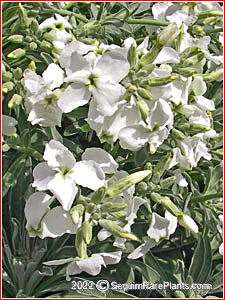
Someimes you will see this plant named as Agave 'Spot,' because it is a close relative of agaves. However this is more deciduous in nature instead of being as evergreen as are agaves. Being deciduous helps it to survive colder winters.


flowers of Melianthuscommonly known as honey bushMelianthus major
This plant grows into a woody shrub about five feet in height, having large fingered, grayish or silvery leaves with a zig-zag pattern to the leaf margins as though they were cut with large pinking shears. Survives our winters although sometimes the stems are killed back in winter and must resprout from the roots. On warm summer days the rubbed leaves have a peanut butter-like scent. Flowers here in early summer with clusters of reddish stems and green blooms above the leaves. When grown in areas that do not freeze, such as parts of California, this can reach eight to ten feet tall. Cold hardy to USDA Zones 7 - 11. Plants that survive in Zones 7 and 8 may freeze to the ground, however will resprout from the roots in spring. If a young plant looks like it has frozen, do not be too quick to dig it out. You might discover signs of life and wish you hadn't disturbed it. Spring and early summer planting is better than planting in the fall. Makes a big statement in a large container with other comparably sized plants. More info, click here. $9.95
sorry, sold out

Mukdenia 'Crimson Fans'Mukdenia rossii 'Crimson Fans'
Clusters of small, white flowers appear on this groundcover in early spring. The fingered leaves are fan-shaped emerging bronze-green, that in strong light turn to crimson at the edges. In shade they will be a medium green. When cold weather arrives in fall, they turn to gold and crimson. Height will be twelve inches on an established plant. This likes partial shade and evenly moist ground throughout summer, and grows better across the cooler, more northerly part of North America. It is a Japanese hybrid of a species that is native to China and Korea. With age the plant will spread out from thick rhizomes. Cold hardy to USDA Zone 4. Also known as Aceriphyllum. More info, click here. $11.95

 
A   B   C   D   E   F   G   H   I   J   K   L   M   N   O   P   R   S   T   V   W   Y top of the page - Sequim Rare Plants

Nepeta 'Forncett Select'Nepeta nervosa 'Forncett Select'
Growing to a size of ten inches tall, this bushy perennial flowers from June through August, bringing welcome color to the late summer garden. Its flowers are a rich violet-blue. Hardy to USDA Zones 5 - 9, this species is native to Kashmir. It likes well-drained soil in sun. Easy to grow and undemanding. More info, click here. $7.95
sorry, sold out

 
A   B   C   D   E   F   G   H   I   J   K   L   M   N   O   P   R   S   T   V   W   Y top of the page - Sequim Rare Plants

fernleaf peonyPaeonia tenuifolia
This peony blooms earlier in the spring season than many other peonies, and usually it goes dormant earlier also. Its new spring leaves can have a reddish tinge, turning green in time. The leaves are narrow and the plant's height will be low at 12 to 18 inches. Flowers have a single row of red petals surrounding a buff of golden stamens It is long lived, growing wider with the years. Plant it in well drained ground in full sun for most of the day. In the Midwest, old plants of fernleaf peony can be found in old, abandoned cemeteries on the prairies, where it receives no care other than what Mother Nature provides. So once established it thrives easily with minimal care. Things that might cause it to struggle are crowding it too closely with taller neighboring plants, or planting where tree roots will compete with it. In addition to the roots, the tree's shade might reduce the flowering. It is winter hardy in USDA Zones 3 to 8, and to Zone 9 along the West Coast. More info, click here. $14.95
sorry, sold out

Paradisea lusitanicaParadisea lusitanica
Thick clumps of grass-like leaves have spires of pure white 1½-inch wide flowers in late spring on this unusual perennial. It is undemanding and easy to grow in a garden. In its native home of northern Portugal and nearby Spain, it grows in damp meadows, marshes and open woodlands. Flower stems reach 2½ to 3 feet. USDA Zones 7 - 9. More info, click here. $8.50

Parahebe, known as digger's speedwellleaves of Parahebe strongly resemble eucalyptus leavesParahebe perfoliata
A native of Australia, this evergreen plant survives to a winter temperature of 10°F. It used to be listed as a Veronica, the flowers of them being similar. Today the naming of the plant is in dispute, the English giving it this name, parahebe, while the Australians give it the name, derwentia. In our mild, coastal climate its leaves are evergreen, and appear exactly as those of a eucalyptus. Never growing taller than about eighteen inches, it does run and spread underground, not as a thick groundcover but more openly. It can take much drought once well acclimated in a new garden. This is still a novelty that surprises many gardeners. More info, click here. $7.95

Parochetus communis blue flowers of ParochetusParochetus communis
Known as both blue oxalis and shamrock pea, this is native to the mountains of Africa and Asia. It is low at 1 to 3 inches tall and spreads widely to a couple of feet or more. The green leaves often have a circle pattern of dark red. The cobalt blue flowers are unbelievable at first sight. Flowers are produced for a long season. Plant it outdoors in the spring to give it a good start, and it will survive over winter to USDA Zone 8b. It is a very vigorous plant that will resprout from its roots if the top of the plant is killed. Potting up a piece of the plant to keep indoors over winter might be a good precaution against the possibility of loosing it. This shamrock pea is content to live planted in a pot year around. In a greenhouse it may well flower all winter. It adds nicely to a hanging basket or deck planter. More info, click here. $7.95

Pelargonium 'African Queen'Pelargonium 'African Queen
These “geraniums” are more accurately Pelargonium x domesticum. In England they are known as regal geraniums and in the U.S. as Martha Washington geraniums or simply as Marthas. They have the same basic needs as the more frequently grown zonal geraniums, except liking less intense sunlight. Give them filtered light, or full sunlight in the morning and shade in the afternoon.
    For watering, we water them thoroughly and then let our plants dry out considerably before watering them again, and lightly spray the foliage in between waterings. To set flower buds and to flower well their second year in your garden they need a cooling down period over winter when you have them indoors. The temperature needs to be lower than 55°F at night but above freezing. So store them near the window of an unheated garage, porch or basement. They can be cut back before being brought inside, but leave a few leaves on at least a few of the branches.
    Most of these beautiful varieties are hard-to-find. Because it takes several months to get them well-rooted from cuttings, please understand that when they run out, more will not be available until the following year. Potting them up and growing them onto flowering size is a slow, careful process. It is worth the wait, seeing their colors.
    'African Queen' has flowers of a rich, royal dark red with an even darker center or blotch to each petal. More info, click here. $4.95

Pelargonium 'Aztec'Pelargonium 'Aztec'
The colors of 'Aztec' are white and strawberry, with the strawberry being elongated blotches down the center of the petals. More info, click here. $4.95

Pelargonium 'Baby Snooks'Pelargonium 'Baby Snooks'
'Baby Snooks' has smaller flowers on a plant that grows large. More info, click here. $4.95

Pelargonium 'Brushfire'Pelargonium 'Brushfire'
Brushfire' has large, firey red flowers with a darker center. More info, click here. $5.95

Pelargonium 'Burghi'Pelargonium 'Burghi'
The flowers are an unusual dark blood-red flowers with even darker veining. More info, click here. $5.95

Pelargonium 'Dapper Burgundy'Pelargonium 'Dapper Burgundy'
The color is a rich red with darker blazes at the base of each petal. The color of this flower is difficult to accurately capture on film. More info, click here. $4.95

Pelargonium 'Dubonnet'Pelargonium 'Dubonnet'
The colors are a rich wine-red. More info, click here. $4.95

Pelargonium 'Edith North'Pelargonium 'Edith North'
Large rounded petals of intense salmon, with the upper two petals having darker veins, describe the flowers of 'Edith North.' More info, click here. $4.95

Pelargonium 'El Gato'Pelargonium 'El Gato'
The flowers are less cup-shaped or trumpet-shaped than normal because the edges of the petals are a bit irregular. However the colors are very rich and vivid -- a stiking red with darker centers, and with a creamy edge to the petals. El gato is Spanish for the word, cat. More info, click here. $4.95
sorry, sold out

Pelargonium 'Elsie Hickman'Pelargonium 'Elsie Hickman'
As the stems grow longer on this plant, they cannot hold themselves upright very well, and tend to splay out and cascade. This is not bad trait when several are planted together as a hanging basket, where the prostrate stems will droop over the container's edges. Each flower has a large white throat. The lower petals are a mid pink, and the upper petals are mostly a rich, very dark red. All three colors stand out well. The petals are large and rounded. The overall effect is very pleasing. More info, click here. $4.95

Pelargonium 'Exquisite'Pelargonium 'Exquisite'
Rounded petals with ruffly edges are a light pink. Each petal has a darker red blotch in its center. More info, click here. $4.95

Pelargonium 'Flower Basket'Pelargonium 'Flower Basket'
This Martha has pink flowers, and her stems grow long and lax, filling out sideways as well as growing taller. So this plant makes a very nice hanging basket when two or three are planted together. And being tolerant of drying out between deep waterings, does very well all summer long, as long as she is given a bit of shade during the hottest part of the summer's day. Strong, but diffuse light would be ideal. More info, click here. $4.95
sorry, sold out

Pelargonium 'Georgia Peach'Pelargonium 'Georgia Peach'
A true “self,” being a pure, solid light pinky salmon. Each flower is large and ruffled. More info, click here. $5.95

Pelargonium 'Josy'Pelargonium 'Josy'
Rich pink flowers with darker blazes in the upper petals. More info, click here. $4.95
sorry, sold out

Pelargonium 'Little Rascal'Pelargonium 'Little Rascal'
'Little Rascal' has smaller flowers on a plant that grows large. More than half of each flower is white. The upper petals are a rich purplish red, rimmed in creamy white. The clusters of small flowers are very showy. More info, click here. $4.95

Pelargonium 'Majestic'Pelargonium 'Majestic'
Reddish salmon with a dark blotch on each of the upper petals. A very lovely flower in shape and color. More info, click here. $4.95

Pelargonium 'Mary'Pelargonium 'Mary'
Mostly a pure, creamy white. There is just a small, light touch of lavender pink at the very center of the upper two petals. More info, click here. $4.95
sorry, sold out

Pelargonium 'Mini Martha'Pelargonium 'Mini Martha'
We do not know the real name of this plant that we inherited. 'Mini Martha' is just our temporary name until someone can tell us what it should be. It has small flowers on a full-sized plant. The colors are white and purplish red. The two upper petals are dark, purplish red with white at the edges. The three lower petals are mostly white with a spot of light purplish red in the center. More info, click here. $4.95

Pelargonium 'New Gypsy'Pelargonium 'New Gypsy'
Its petals are much thinner, giving it a star-like shape to the flower. Combines a variety of colors in white, pink and dark red, with dark blotches on the upper petals. More info, click here. $4.95

Pelargonium 'Orange Parfait'Pelargonium 'Orange Parfait'
This has a strong, rich reddish salmon, with ruffled edges, a rounded shape and a lighter heart. More info, click here. $5.95

Pelargonium “Pansy Face”Pelargonium “Pansy Face”
The uppper two petals are a rich magenta with dark veins. The lower three petals are a pure white. Each flower is airy and light, and are grouped in clusters of several flowers per stem. More info, click here. $4.95

Pelargonium 'Picasso Pink'Pelargonium 'Picasso Pink'
The flowers are multicolored, with creamy throats that blend to light pink and then darker reddish-pink edges, with a tracery of fine darker veins. More info, click here. $5.95

Pelargonium 'Pompeii'Pelargonium 'Pompeii'
Dark velvety red with a thin light edge to each petal. More info, click here. $4.95

Pelargonium 'Rogue'Pelargonium 'Rogue'
'Rogue' has wide petals of dark red with darker blotches in the center of the petals. More info, click here. $4.95

Pelargonium 'Salmon Splendor'Pelargonium 'Salmon Splendor'
Rich orange-salmon with dark blotches to each petal. More info, click here. $5.95

Pelargonium 'Variegated Peach Princess'Pelargonium 'Variegated Peach Princess'
Pastel pink flowers adorn plants with large leaves of green, edged in cream. More info, click here. $6.95
sorry, sold out

Pelargonium 'White Champion'Pelargonium 'White Champion'
A large, pure white flower that is ruffled. More info, click here. $5.95

Phormium 'Platt's Black'Phormium 'Platt's Black'
(New Zealand flax) This could have the darkest leaf of the phormiums -- it is among the darkest we have seen. But a lot depends on where you place it. In full sun its color will be darker than if planted in any shade, where it will be lighter. Its mature height is two to three feet. It will grow quicker and look better with regular, deep watering. Older plants can take more drought. Cold hardy to 15 to 20°F. It is reported to not to grow as well in Southern California as it does in cooler climates. Originally from Platt's Native Plants in Auckland, New Zealand. More info, click here. $9.95
sorry, sold out

flowers of Podophyllumleaf of Podophyllum pleianthumPodophyllum pleianthum
The common name for this is Chinese mayapple. It has large, shiny rounded leaves from one to two feet tall. They may grow to the size of a large dinner plate and are very decorative. Richly dark red flowers bloom on the leaf-stems underneath the leaves, so they do not show up well unless the plant is grown elevated, such as on a hillside. The flower buds do not open all at once, but one after another. An older plant will have many buds so that the flower season lasts for quite some time. This plant is a close relative of the mayapple that is native to the eastern states of the USA, Podophyllum peltatum, but whereas the American mayapple goes dormant well before summer's end, this Chinese mayapple continues in good condition until autumn frosts. It needs shade all day long to be happy, because direct sunlight will burn any part of the leaf that it touches. Hardy in USDA Zones 6 - 8, and to Zone 9 along the Pacific Coast. More info, click here. $12.95
sorry, sold out

Polemonium 'Stairway to Heaven'Polemonium 'Stairway to Heaven'Polemonium 'Stairway to Heaven'
(PP# 15,187) A variegated form of jacob's ladder that is native to North America, this has leaves of cream and green, sometimes with pink highlights. New fresh leaves continue to appear all season, keeping it attractive from spring to late fall. Afternoon shade is best where summers are hot. Height is 10 to 15 inches. Lightly tinted flowers of violet-blue open in mid to late spring. This grows much more robustly than another variegated jacob's ladder named 'Brise d'Anjou,' and lasts longer. Not to pick on the Europeans, but 'Brise d'Anjou' comes from an European species of Polemonium, while 'Stairway to Heaven' comes from a species native to North America. Hardy in USDA Zones 4 - 8. More info, click here. $7.95

Solomon's seal, PolygonatumPolygonatum odoratum 'Variegatum'
This is a long-lived and choice flowering perennial, with its regal, upright form, attractive pairs of flowers and leaves that are edged in cream. The creamy edges brighten up a woodland or shady garden. And the leaves turn light yellow before dropping off in fall. It grows well as far north as USDA Zone 3 and as far south as Zone 8 in the East, and Zone 9 in the West. More info, click here. $9.95

Primula auricula 'American Beauty' Primula auricula 'American Beauty'
The next few plants on this list are primroses, particularly the succulent, evergreen type known as auriculas. This is a species native to the Alps mountain range of central Europe. It grows at high elevations, often above the tree line, so can take severe cold. The varieties offered here are the results of selections and breeding over several centuries. Some historians believe auriculas to be the earliest plants grown in pots and containers in Europe. As lovely as they are, keeping them alive long-term can be a challenge. The best advice is to grow them where they will have partial shade during the afternoon, especially during the heat of summer.

'American Beauty' has flowers of clear red with white eyes, and fleshy green leaves. As with most of the auriculas, the height of the flowering stems is typically about half a foot. Cold hardy to −35 to −40°F, with protection such as snow cover. More info, click here. $8.95


Primula auricula 'Andrea Julie'Primula auricula 'Andrea Julie'
'Andrea Julie' has rich reddish flowers with lighter edges to her petals. The petals are beautifully rounded. And the center eye of a flower is a rich gold. As with other auriculas, a mature plant will give many flowers beginning in April and running into the month of May. Cold hardy to −35 to −40°F, with protection such as snow cover. More info, click here. $7.95

Primula auricula 'Arctic Fox'Primula auricula 'Arctic Fox'
A double flower in reddish-purple, it was selected and named by Linda Tinnity and Jim Fox. Vigorous, thriving in Alaska without protection. As with other auriculas, a mature plant will give many flowers beginning in April and running into the month of May. Cold hardy to −35 to −40°F, with protection such as snow cover. More info, click here. $10.95

Primula auricula 'Argus'Primula auricula 'Argus'
Dark red petals that are a lighter pinkish-red at their edges, 'Argus' is an old primrose that was selected and named in 1897, over one hundred years ago. The eye in the center is a light, cream. Cold hardy to −35 to −40°F, with protection such as snow cover. More info, click here. $8.95

Primula auricula 'Arundel'Primula auricula 'Arundel'
'Arundel' has multi-colored flowers of reddish coloring and creamy green. Sometimes its name is given as, 'Arundel Stripe.' This is a very vigorous plant. If the flowers are left on the plant to ripen, many seeds can be collected from it in July. If sown and grown on to flower themselves, the colors of their flowers oftentimes will be striped, however not precisely duplicating the colors of 'Arundel.' Cold hardy to −35 to −40°F, with protection such as snow cover. More info, click here. $6.95

Primula 'Astolat'Primula auricula 'Astolat'
Petals of green and medium-red surround a ring of white that is Very pleasing, and fancy. Cold hardy to −35 to −40°F, with protection such as snow cover. More info, click here. $10.95

Primula 'Barbara Weinz'Primula auricula 'Barbara Weinz'
The petals are large, and a dark blue-purple, encircling a well formed white eye. The plant is compact and vigorous. This plant was first grown by Barbara Weinz of West Bath, Maine, who grew it from seeds acquired from Herb Dickson. More info, click here. $9.95
sorry, sold out

Primula 'Brazil'Primula auricula 'Brazil'
'Brazil' is colored a rich tawny yellow. It is a vigorous show auricula bred by the British nurseryman, Derek Telford. More info, click here. $9.95
sorry, sold out

Primula 'Brown Bess'Primula auricula 'Brown Bess'
Reddish-brown shaded to light beige with a gold center. More info, click here. $9.95

Primula auricula 'Chehalis Blue'Primula auricula 'Chehalis Blue'
'Chehalis Blue' honors the memory of Herb Dickson's nursery that specialized in growing auricula primroses for many years in Chehalis, Washington. The flower is not perfect since its petals are notched, although it is a lovely shade of blue with a creamy eye. Cold hardy to −35 to −40°F, with protection such as snow cover. More info, click here. $9.95

Primula 'Cornmeal'Primula auricula 'Cornmeal'
The petals are heavily dusted in powdery meal. They are a grayish green with a blaze of black at their bases, creating a circle of inky blackness surrounding an inner circle of white and a yellowish eye. The white circle ages to a similar color as the eye. Grown by Cyrus Happy. Classified as a gray-edged show auricula. More info, click here. $10.95
   If you can find a copy of the book Perennials, a Time-Life book, published in 1972 and written by James Underwood Crockett, you can see a photo on page 71 of the person, Cyrus Happy, who selected and named this primrose. The caption that accompanies the photo states, “Cyrus Happy, a photographer-editor of industrial publications who lives in Tacoma, Washington, displays some of his prized collection of auriculas on a wrought-iron stand that is a relic of the Victorian period in England, when primrose gardens were fashionable.”
   Incidentally, this book is one of the best ever written on the subject of herbaceous perennials -- for its clarity, breadth of knowledge, quality of photographs, and the inspiration it offers to budding gardeners.

Primula auricula 'Dale's Red'Primula auricula 'Dale's Red'
'Dale's Red' is a rich red, slightly lightening at the edges. A vigorous grower. Cold hardy to −35 to −40°F, with protection such as snow cover. More info, click here. $8.95
sorry, sold out

Primula auricula 'Doublet'Primula auricula 'Doublet'
'Doublet' has double flowers with rich purple petals. We have more doubles that will be offered in the future as their numbers increase. Cold hardy to −35 to −40°F, with protection such as snow cover. More info, click here. $8.95

Primula 'Douglas Black'Primula auricula 'Douglas Black'
'Douglas Black' is a “self” of very dark red petals that are near to black. More info, click here. $9.95

Primula auricula 'Emily P.'Primula auricula 'Emily P.'
Double flowers with creamy petals of very light pink and very light yellow. Cold hardy to −35 to −40°F, with protection such as snow cover. More info, click here. $10.95

Primula auricula 'Gordon Douglas'Primula auricula 'Gordon Douglas'
Deep reddish-purple, lightening at the edges. Cold hardy to −35 to −40°F, with protection such as snow cover. More info, click here. $8.95

Primula 'Graham Stripe'Primula auricula 'Graham Stripe'
Selected by Rick Lupp of Mt. Tahoma Nursery, located near Graham, Washington, the flowers of 'Graham Stripe' have a creamy white background with dark striping. The flowers are especially well shaped. More info, click here. $8.95

Primula 'Green Shank'Primula auricula 'Green Shank'
Classified as a “fancy” auricula, 'Green Shank' is equally colored in green, rich red and white, with green and red petals and an inner ring of white. More info, click here. $9.95
sorry, sold out

Primula 'Hawkwood'Primula auricula 'Hawkwood'
'Hawkwood' is a fancy auricula. Each of its flowers has a thin, fine edge of gray, with maroon-red petals, and a large white eye. Limited quantity. More info, click here. $10.95
sorry, sold out

Primula 'Haysome'Primula auricula 'Haysome'
This is a show auricula with gray petals and a thin line of black or very dark red, at the petals' bases, surrounding a white eye. The leaves have a dusting of farina coloring them in a silvery cast. Cold hardy to −35 to −40°F, with protection such as snow cover.
   Whether the name of this variety should have an “e” at its end or not, we are uncertain about. The plants we originally purchased in the U.S. were named 'Haysome,' however we see on the internet that two auriculas are named for people with the surname of Haysom ('Alice Haysom' and 'C. G. Haysom'). And that some of the photographs on the internet of 'C. G. Haysom' closely match the flowers of our plants. If anyone reading this can provide definitive information, we would appreciate hearing from you. More info, click here. $10.95
sorry, sold out

Primula auricula 'Jeffa'Primula auricula 'Jeffa'
'Jeffa' has a single row of rich purple petals that lighten at their edges. As with all of these Primula auriculas, several flowers are grouped together in a cluster on one stem. Cold hardy to −35 to −40°F, with protection such as snow cover. More info, click here. $8.95

Primula auricula 'Karen Cordrey'Primula auricula 'Karen Cordrey'
Flowers are green at the edges of the petals, and a dark, blackish red, with a ring of white at the eye. Cold hardy to −35 to −40°F, with protection such as snow cover. More info, click here. $7.95

Primula 'Lincoln Chestnut'Primula auricula 'Lincoln Chestnut'
Double flowers of cinnamon-brown, orignially from Derek Salt. More info, click here. $10.95
sorry, sold out

Primula auricula 'Marie Crousse'Primula auricula 'Marie Crousse'
Double purplish-mauve flowers. (Not to be confused with a double polyanthus primrose that has the same name.) Cold hardy to −35 to −40°F, with protection such as snow cover. More info, click here. $10.95

Primula 'Marmion'Primula auricula 'Marmion'
The petals have a green edge and a black base, surrounding a ring of pure white, with the a light yellow inner eye. This beauty grows vigorously. Cold hardy to −35 to −40°F, with protection such as snow cover. More info, click here. $9.95
sorry, sold out

Primula 'Old Mustard'Primula auricula 'Old Mustard'
'Old Mustard' has medium tan flowers with white eyes. The clusters of flowers come on especially tall stems to eight inches. More info, click here. $8.95
sorry, sold out

Primula auricula 'Orwell Tiger'Primula auricula 'Orwell Tiger'
Striped flowers of dark blood-red on a cream base. Sometimes the cream base is mixed with light yellow. Cold hardy to −35 to −40°F, with protection such as snow cover. More info, click here. $9.95

Primula auricula 'Osbourne Green'closeup of Primula auricula 'Osbourne Green'Primula auricula 'Osbourne Green'
The shape of this flower is different from most of these primroses. It is long and funnel shaped with a cream center surrounded by an edge of purple tinged green. The plant has large leaves and is suitable for setting out in the ground in addition to being grown in a pot. Cold hardy to −35 to −40°F, with protection such as snow cover. More info, click here. $6.95

Primula auricula 'Parakeet'Primula auricula 'Parakeet'
The colors of 'Parakeet' blend cream, light yellow and green together. Cold hardy to −35 to −40°F, with protection such as snow cover. More info, click here. $6.95

Primula auricula 'Pegasus'Primula auricula 'Pegasus'
'Pegasus' has intense blood-red flowers that are double. Cold hardy to −35 to −40°F, with protection such as snow cover. More info, click here. $10.95

Primula auricula 'Remus'Primula auricula 'Remus'
A rich, royal purple self with a white eye, and nicely contrasting silvery foliage. Cold hardy to −35 to −40°F, with protection such as snow cover. More info, click here. $8.95

Primula auricula 'RN-25'Primula auricula 'RN-25'
'RN-25' is similar in coloring to 'Karen Cordrey,' with colors of green, dark red (almost black) and white. Cold hardy to −35 to −40°F, with protection such as snow cover. More info, click here. $7.95

Primula 'Robinette'Primula auricula 'Robinette'
Double flowers. The young flower buds are dark at first, and lighten as they open to a rich, ruby-red. More info, click here. $10.95

Primula auricula 'Rosemary'Primula auricula 'Rosemary'
'Rosemary' has beautifully rounded petals of rich red flowers. The center of each flower is a pure white. The leaves are green and have a lightly spicy scent. Cold hardy to −35 to −40°F, with protection such as snow cover. More info, click here. $8.95

Primula auricula 'Sandra'Primula auricula 'Sandra'
A delight of rose-red that is paler at the edges of the petals, and with a creamy eye at the center. Cold hardy to −35 to −40°F, with protection such as snow cover. More info, click here. $9.95
sorry, sold out

Primula auricula 'Sirius'Primula auricula 'Sirius'
'Sirius' is very different with the maroon at the base of each petal and the edges shaded in cream, with a golden center. Lightens as it ages. Cold hardy to −35 to −40°F, with protection such as snow cover. More info, click here. $9.95
sorry, sold out

Primula auricula 'Stripey'Primula auricula 'Stripey'
'Stripey' is an unusual, double flowered auricula. The colors are creamy white and purplish-red, sometimes with the background color being purplish-red with creamy stripes and other times the reverse, a creamy white background and purplish-red stripes. Limited quantity - limit of one per order, please. Cold hardy to −35 to −40°F, with protection such as snow cover. More info, click here. $10.95

Primula auricula 'Susannah'Primula auricula 'Susannah'
Described as a light, muted lavender-pink, her flowers are double. Cold hardy to −35 to −40°F, with protection such as snow cover. More info, click here. $8.95

Primula 'Sword'Primula auricula 'Sword'
Most of the green-edged auricula primroses that you will come across will have a single row of petals. But here is something unusual, one with a double flower. It is lovely in addition to growing most vigorously. Cold hardy to −35 to −40°F, with protection such as snow cover. More info, click here. $9.95

Primula auricula 'Trudy'closeup of red Primula auricula 'Trudy'Primula auricula 'Trudy'
This is the cluster of red flowers on the homepage of this website, in the upper righthand corner. Her petals are a rich dark red surrounding a clear white eye. Especially attractive are the leaves with their covering of silvery meal. Cold hardy to −35 to −40°F, with protection such as snow cover. More info, click here. $8.95
sorry, sold out

Primula marginata 'Herb Dickson'Primula marginata 'Herb Dickson'
This species of primrose, marginata, has leaves that are gently toothed along the edges. It likes the same growing conditions as the auriculas. Its color is a medium violet. Cold hardy to −35 to −40°F, with protection such as snow cover. More info, click here. $6.95

Primula marginata 'White Linda Pope'Primula marginata 'White Linda Pope'
Toothed margins of the leaves define this species of primrose. Large white flowers bloom in late March to early May. The leaves are succulent and often dusted in a silvery-gray meal. The flowers of 'White Linda Pope' grow to about six inches tall. The leaves are lower, and grow slowly into a widening clump. It is evergreen and is decorative in leaf when not blooming. Native to mountainous regions, it is quite cold hardy, to minus 30°F, or even colder where there is winter snow.
Limited quantity -- limit of one per order, please. More info, click here. $11.95

Primula 'Belarina Cream'Primula 'Belarina Cream'
This fully double primrose has petals of light cream. The height of a plant will be six inches. It likes a humus-rich soil in partial shade. Withstanding winter cold to USDA Zone 5 with protection, it will survive from year to year as a true perennial in regions where summers are not humid and hot. In other words this is more of an annual in the South. The creamy flowers are fragrant, too ! More info, click here. $5.95

Primula 'Belarina Butter Yellow'Primula 'Belarina Butter Yellow'
The flower is fully double, in a butter yellow color. A plant's height will be six inches. Hardy in USDA Zones 6 - 9, Zone 5 with protection. More info, click here. $5.95

Primula 'Belarina Cobalt Blue'Primula 'Belarina Cobalt Blue'
Double flowered primroses have been scarce and have been prized by gardeners for generations. The round pom poms of 'Belarina Cobalt Blue' are a very rich, dark blue, truly tinted in cobalt. We offer another blue, double primrose named 'Blue Sapphire' that is closer to a medium blue and not as darkly shaded. This cobalt color is difficult to accurately catch on film -- depending on your computer's monitor the color may be less true to life than this flower is “in the flesh.” Is there any other flower with as dark, and rich a blue as this? Hardy in USDA Zones 6 - 9, Zone 5 with protection. More info, click here. $5.95
sorry, sold out

Primula 'Belarina Nectarine'Primula 'Belarina Nectarine'
A more unusual color in a double flower is 'Nectarine,' a combination of light and darker yellow and orange. Perennial where summers are not hot and humid, this expands into a thick clump over several years. The thick clump can easily be divided in fall or spring to make several plants. Hardy in USDA Zones 6-9, Zone 5 with protection. More info, click here. $5.95
sorry, sold out

Primula 'Belarina Pink Ice'Primula 'Belarina Pink Ice'
Light pink in a double flower. Blooms for many weeks in spring and again when cool weather arrives in autumn. Height of six inches. Hardy in USDA Zones 6 - 9, Zone 5 with protection. More info, click here. $5.95

Primula 'Blue Sapphire'closeup of Primula 'Blue Sapphire'Primula 'Blue Sapphire'
The leaves are low and partially evergreen. The flowers begin to appear in early spring. For us they start in late Februry and continue on well into summer. When planted in just the right spot they can flower here year around. They would prefer a rich soil, light shade and slightly more moisture than average when they can get it, however will grow well in full sun and with less than perfect conditions. 'Blue Sapphire' has fully double flowers, two or three per stalk, of a rich, dark blue that are often thinly rimmed in silver. They are favorite food for slugs and deer. Hardy in USDA Zones 6 - 9, Zone 5 with protection. More info, click here. $5.95

Primula 'Penumbra'Primula polyanthus 'Penumbra'
Multicolored flowers of black with a wide white edging and golden eyes are showy and very bright. The flowers come in clusters atop four-inch stems in spring and again in fall. The leaves are light green and can be evergreen depending on the severity of the winter. USDA Zones 6 to 9, to Zone 5 with protection. With good snow cover it is routinely carried over winter in Zones 3 and 4. Limited quantity. More info, click here. $5.95

closeup of Primula 'Tie Dye'Primula 'Tie Dye'Primula polyanthus 'Tie Dye'
With large blue and white flowers, the name of this primrose is appropriate for its unique look. Four-inch high stems carry clusters of flowers in spring and again in autumn. The leaves are light green and can be evergreen depending on the severity of the winter. USDA Zones 6 to 9, to Zone 5 with protection, and even to Zone 3. Limited quantity. More info, click here. $5.95

 
A   B   C   D   E   F   G   H   I   J   K   L   M   N   O   P   R   S   T   V   W   Y top of the page - Sequim Rare Plants

Saxifraga paniculata ssp. petrophilaRock Garden Plants
Click here to go to a new page of plants for a rockery.
 

butterfly rose, Rosa 'Mutabilis'Rosa x odorata 'Mutabilis'
Flowering all summer long, this shrub rose grows to three feet tall in northern climates and to six feet tall in southern climates.Young shoots are purplish and the new leaves are coppery. Its flowers change color as they age and are unscented. The unopened buds are apricot-pink, then open to buff, next becoming a mixture of apricot, rose, and crimson. Each flower is two to three inches across. Sometimes called the butterfly rose, it was brought back from China during the Victorian era and has had a variety of names over the years. Today it is thought to be a cross of Rosa chinensis with Rosa gigantea. To some degree it is evergreen, with leaves remaining on the branches over winter. Do not prune it hard, but only enough to keep it within bounds or to remove dead wood. Winter hardy to USDA Zone 6. More info, click here. $8.95

red-veined dockRumex sanguineus ssp. sanguineus
Easily grown, the attractive leaves of this perennial have richly red veins on their long pointed green leaves. The leaves are edible, with the youngest leaves being the best ones to harvest.They can be used much like spinach or chard, either uncooked in a fresh salad or steamed as a side dish. The older leaves will be tougher, however could be chopped and cooked in a stir-fry. This red-veined dock prefers moist soil although it grows well in drier gardens if watered regularly. It is robust enough to survive in dry conditions, by temporarily shedding its oldest leaves. It flowers early in the summer, although the flowers are best removed as they are not especially colorful, being small and green, turning reddish-brown as they mature. Removing the flowers encourages a plant to produce a continuous crop of new leaves throughout summer. A plant of this is easily propagated in spring by digging it and dividing into several pieces. Height of twelve to fifteen inches. More info, click here. $5.95

 
A   B   C   D   E   F   G   H   I   J   K   L   M   N   O   P   R   S   T   V   W   Y top of the page - Sequim Rare Plants

Salvia africana-luteacloseup of Salvia africana-luteaSalvia africana-lutea
This large 1 to 1½-inch flower has a rich and unusual color of warm chocolatey brown. It also has an attractive largish cup-shaped purplish calyx after the petals fall off . The flowerbud starts a lighter color but soon changes to brown. Flowers come in open clusters on short stems above the foliage. The leaves are wavy, aromatic and tinted a grayish-green. The stems hold themselves up well without flopping. Because of their spicy fragrance, the leaves and flowers are good additions to potpourri. And also because the flower keeps its interesting shape when dried. Native to Africa, where it is known as dune sage, a plant grows to six feet and and is often found at seaside. Being hardy only to USDA Zones 9 to 11, we enjoy it outdoors during the summer, and start new plants the following spring. In a container or in the ground, it would combine nicely with many other sun-loving plants. It grows quickly and is undemanding. Not often seen until recently, even in California. Our plants are not grown from seeds but from cuttings, and will match the color of the photos. More info, click here. $5.95

 richly blue flowers of Salvia daghestanicaSalvia canescens var. daghestanicaSalvia canescens var. daghestanica
Salvia daghestanica likes a hot, sunny position in any well-drained soil. Grow it just like lavender -- it doesn't want to be wet at the roots or heavily watered. When planting, mixing in a ample helping of coarse grit and planting it on a slightly raised mound of soil to aid drainage should help it survive a wet winter. Another idea is to mulch it with two to three inches of sand when planting. A native to the Caucasus Mountains near the Black Sea. In early summer, the low, tight rosettes of textured foliage are very white and create a superb backdrop to the showy 8 to 10-inch tall spikes of large clear-blue flowers. Besides planting in a rock garden it can be used in the perennial border as an edging plant and as a companion around taller plants. USDA Zones 5 - 8. More info, click here. $7.95

flower of Salvia elegans 'Golden Delicious'Salvia elegans 'Golden Delicious'Salvia elegans 'Golden Delicious'
(PP# 17,977)(pineapple sage) Winter hardy to USDA Zones 9 to 11, this tender perennial is content to grow in a pot that can be put outside during summer's warm weather and brought indoors during winter's cold. In places where it can be grown outdoors year around it reaches a height of several feet. In a container you will determine the plant's height by the size pot you give it. It becomes pot-bound quickly. Being pot-bound is not a problem for it -- you will get more flowers when it is, but you will also have to water it more frequently. It likes lots of light, and adapts to frequent pruning if you should want to keep it small. The flowers are a blazing red, and long blooming. The leaves are lemon yellow and are scented strongly of something like pineapple. The leaves can be safely nibbled, so this bright and fragrant plant is useful as a garnish for the dining table. More info, click here. $7.95

Salvia greggii 'Desert Blaze'Salvia greggii 'Desert Blaze'
(PP# 8,560) This salvia is woody and will grow into a shrub two feet tall. It is native to parts of Texas, and is hardy to USDA Zones 8 - 10, and Zone 7 with protection. Otherwise carry it over winter in a greenhouse or take a few cuttings in late summer to place on a windowsill. In warm regions it flowers in spring and fall, and intermittently during summer after rain. In cooler places it begins to flower in mid-summer and continues non-stop until fall. Its flowers are a bright red and the small semi-evergreen leaves are white and green. Even when out of flower the woody structure of the plant is decorative. We mostly use it in pots and planter boxes, cutting it back to bring indoors at the end of summer. Give it as much sunlight as possible. It can be pruned hard, cutting back by half when it grows too big. Deer do not bother it and hummingbirds love it, the perfect combination for wildlife in your garden. More info, click here. $7.95

Saxifraga stolonifera 'Harvest Moon'Saxifraga stolonifera 'Harvest Moon'
Although one common name for this plant is strawberry begonia, it is neither a strawberry nor a begonia. But it is low and spreads by runners the way strawberries do, and there is something about the leaves of this saxifrage that is reminiscent of a tuberous begonia's leaves, maybe being lightly hairy and having a similar texture? 'Harvest Moon' prefers more shade than sun, however if grown in too much shade the leaves will be more green than golden. So a fair degree of bright sunlight is necessary. You will notice on a plant that the upper leaves will be more golden, whereas the lower, more shaded leaves will be darker and greener. It has tiny white flowers on stems twelve to fifteen inches tall in late spring to early summer. Despite the fact that it does spread by runners, it is one of the easiest plants to keep under control because the plants are so often delicately rooted into the ground. It tolerates dry gound well, and would be a good choice for a groundcover in dry shade. When grown in a pot let the soil dry out considerably more than you would most potted plants. It can also absorb moisture through its leaves, so misting the leaves between watering the soil is helpful. When grown in a pot, if its soil is kept constantly wet, the roots will rot. This carefulness with its watering is also reminiscent of the care that is needed with watering tuberous begonias. USDA Zones 5 - 9. This plant thrives on neglect. More info, click here. $7.95
sorry, sold out

Saxifraga stolonifera 'Tricolor'Saxifraga stolonifera 'Tricolor'
Lightly hairy evergreen leaves are edged in cream with pink highlights. This perennial is hardy from USDA Zones 5 to 9. One of its common names is mother of thousands, referring to the many baby plants that will grow from it on runners. One plant can become a carpet of many plants. Although others recommend growing it in moist but well drained soil, our experience suggests that is it better to let the soil dry out considerably between infrequent waterings. The rocky cliffs of Japan and China that are its native home often have little soil, but instead have a very moist atmosphere, so the plant is adapted to drawing the moisture it needs from its leaves as much as from its roots. Its name Saxifraga, comes from the Latin words for rock (saxum) and break (frangere), in reference to where it is found in the wild. Delicate clusters of small white flowers rise to 15 inches in spring into summer. More info, click here. $7.95
sorry, sold out

Scopolia carniolicaScopolia carniolica
This uncommon perennial grows from a flattened, tan tuber just below the soil surface. In spring new flowers appear before the young leaves fully open. The blossoms are golden yellow and dark reddish on the outside, and cup shaped. They last for several weeks. The mature height will be 15 to 24 inches. Its native home is the eastern Alps and Carpathian mountains of Europe. It belongs to the Solanaceae family. Care should be used in handling it -- not to rub your eyes if you get any of the sap on your hands. Cold hardy to USDA Zone 5. More info, click here. $9.95

false Solomon's seal, Smilacena racemosaSmilacena racemosa
“false Solomon's seal” This native woodland perennial is seen less in gardens than it deserves. The upright, arching stems have lots of style with their broadly oval leaves and fluffy heads of fragrant creamy-white flowers in late spring, followed with large berries that turn red by fall. Slowly spreading into a widening clump, it is well behaved. A newer name for this plant is Maianthemum racemosum. Hardy and undemanding in USDA Zones 4 - 8 in the East, Zone 4 - 9 in the West. More info, click here. $11.95
     Some gardeners might be confused between this plant and another plant popularly known as “Solomon's seal,” Polygonatum odoratum, which we also offer on this website. They are both lovely plants. However, if you are wanting the one that is fragrant, this one, Smilacena, is the one to get. Even though the other one, Polygonatum odoratum, is the one you think would be fragrant because of its name, quite often the plants of it offered by nurseries are unscented. The fragrance of Smilacena is strong enough that you do not have to ask yourself if there is anything wrong with your sniffer. The other one, Polygonatum odoratum, is well worth growing despite its lack of scent due to its regal, upright form, attractive pairs of flowers and leaves that are edged in cream.

 Succulents that can take severe winter cold  
Jovibarba heuffelii 'Beacon Hill'Jovibarba heuffelii 'Beacon Hill'Succulent - cold hardy
Jovibarba heuffelii 'Beacon Hill'
'Beacon Hill' combines rosy-purple and gray-green on its satiny leaves. Native to the the Balkans and southern Carpathian mountains, it survives winter temperatures to USDA Zone 4 (-20° to -30°F). More info, click here. $5.95

Jovibarba heuffelii 'Fandango'dividing this succulentSucculent - cold hardy
Jovibarba heuffelii 'Fandango'
The leaves are green with red tips, and having short, small hairs on the leaf edges. Cold hardy to USDA Zone 4 (-20° to -30°F). More info, click here. $5.95

The photo on the right is shown to give you an idea how to propagate this species of jovibarba. A group of the round, leafy rosettes are usually tightly clustered together, more tightly than you might expect -- and they generally do not produce long runners as Sempervivums do. So instead of simply pulling them apart as with other succulents you must cut them with a knife, as has been done with the plant in the picture. And it is important to let the freshly cut tissue air-dry for several days before replanting.


Jovibarba heuffelii 'from Jakupica'Jovibarba heuffelii 'from Jakupica'Succulent - cold hardy
Jovibarba heuffelii 'from Jakupica'
Green stained a red-brown on the tips is the coloring of the sharply pointed leaves. Cold hardy to USDA Zone 4 (-20° to -30°F). More info, click here. $5.95

Jovibarba heuffelii 'Gold Bug'Succulent - cold hardy
Jovibarba heuffelii 'Gold Bug'
The photo was taken on March 1st, and is golden. At other times 'Gold Bug' will be green with reddish tips. Jovibarbas change colors, often dramatically during the year. Cold hardy to USDA Zone 4 (-20° to -30°F). Limited quantity - limit of one per order, please. More info, click here. $9.95
sorry, sold out

Jovibarba heuffelii 'Greenstone'Succulent - cold hardy
Jovibarba heuffelii 'Greenstone'
Maroon at the tips of green leaves, with the leaves becoming darker in the winter. Cold hardy to USDA Zone 4 (-20° to -30°F). More info, click here. $5.95

Jovibarba heuffelii 'Hot Lips'Succulent - cold hardy
Jovibarba heuffelii 'Hot Lips'
The leaves are dark red with green at the base, outlined in silver. Cold hardy to USDA Zone 4 (-20° to -30°F). More info, click here. $5.95

Jovibarba heuffelii 'Inferno'Succulent - cold hardy
Jovibarba heuffelii 'Inferno'
This plant grows large, having maroon-red leaves, and some green deep in the heart of the plant. Cold hardy to USDA Zone 4 (-20° to -30°F). More info, click here. $5.95

Jovibarba heuffelii 'Irene'Succulent - cold hardy
Jovibarba heuffelii 'Irene'
The heart of the plant is green. The leaves are mostly a rich, medium red, being a lighter red closer to the center of the plant and a darker red towards the leaf tips. The leaf edges standout with a lighter coloring, due to the small hairs lining the edges. Cold hardy to USDA Zone 4 (-20° to -30°F). More info, click here. $5.95

Jovibarba heuffelii 'Mystique'Succulent - cold hardy
Jovibarba heuffelii 'Mystique'
Shading to a darker purplish-red towards the ends of the leaves, the leaves are mostly this dark purplish-red with a small amount of green, down close in the heart of the rosette of leaves. The proportions of the leaves tend to be shorter and broader. Cold hardy to USDA Zone 4 (-20° to -30°F). More info, click here. $5.95

Jovibarba heuffelii 'Palaisii'Succulent - cold hardy
Jovibarba heuffelii 'Palaisii'
The leaves are mostly a rich green. There is a small touch of dark maroon-red at the tips. Cold hardy to USDA Zone 4 (-20° to -30°F). More info, click here. $5.95

Jovibarba heuffelii 'Purple Haze'Jovibarba heuffelii 'Purple Haze'Succulent - cold hardy
Jovibarba heuffelii 'Purple Haze'
The leaves are mostly a gray-green, and having a cast or shading of muted red. The hairs lining the leaf edges give a lighter color to the leaf edges. Cold hardy to USDA Zone 4 (-20° to -30°F). More info, click here. $5.95

Jovibarba heuffelii 'Sundancer'Succulent - cold hardy
Jovibarba heuffelii 'Sundancer'
The green leaves are tipped in a blood red. At other times of the year the lear are more golden or yellowish. Cold hardy to USDA Zone 4 (-20° to -30°F). More info, click here. $5.95

Jovibarba heuffelii 'Tan'Succulent - cold hardy
Jovibarba heuffelii 'Tan'
The wide leaves are a bronzy red with a little bluish-green at the base. Cold hardy to USDA Zone 4 (-20° to -30°F). More info, click here. $5.95

Jovibarba heuffelii 'Torrid Zone'Jovibarba heuffelii 'Torrid Zone'Succulent - cold hardy
Jovibarba heuffelii 'Torrid Zone'
The leaves are lined with hairs and are a coppery-red. Cold hardy to USDA Zone 4 (-20° to -30°F). More info, click here. $5.95

Jovibarba heuffelii 'Violet'Jovibarba heuffelii 'Violet'Succulent - cold hardy
Jovibarba heuffelii 'Violet'
The leaves are equally colored in a rich violet-purple and in green. Sometimes the violet-purple is darker and extends over more of the leaf surfaces. Cold hardy to USDA Zone 4 (-20° to -30°F). Limited quantity - limit of one per order, please. More info, click here. $5.95

Jovibarba heuffelii 'Wotan'Jovibarba heuffelii 'Wotan'Succulent - cold hardy
Jovibarba heuffelii 'Wotan'
Purplish-red on the leaf tips, and the green towards the leaf bases are 'Wotan's' colors. Cold hardy to USDA Zone 4 (-20° to -30°F). More info, click here. $5.95

Jovibarba heuffelii 'Xanthoheuff'Succulent - cold hardy
Jovibarba heuffelii 'Xanthoheuff'
The “xantho” in this name relates to the yellow coloring of the leaves. The plant is a bright yellow, especially when grown in bright light and during springtime -- at times it is more of a chartreuse green, still a lovely color to contrast with the other succulents on our list. Cold hardy to USDA Zone 4 (-20° to -30°F). More info, click here. $6.95
sorry, sold out

Sempervivum 'Atroviolaceum' Succulent - cold hardy
Sempervivum 'Atroviolaceum'
A deep red violet is the color. The plants grow large. The leaves are smooth, and the edges of the leaves a lightly serrated. Cold hardy to USDA Zone 3 (-30° to -40°F). More info, click here. $4.95

As is true for the other group of hardy succulents listed on this website, the jovibarbas, applies equally to the sempervivums, that showing each variety of these with a single photo is not completely accurate, because the colors change throughout the year. And sometimes the color change is dramatic. Not only do their colors change according to the season, but also according to how wet or dry they are grown, and also by how much sun or shade they are getting, and additionally they are affected by how rich or lean their diet might be. Here is a link to a group of photos (click here) taken April 8, 2010 for a side-by-side comparison.


Sempervivum 'Black Mountain'Succulent - cold hardy
Sempervivum 'Black Mountain'
The plant is mostly a dark reddish maroon, with green are the heart of the plant. Cold hardy to USDA Zone 3 (-30° to -40°F). More info, click here. $4.95

Sempervivum 'Blue Boy'Succulent - cold hardy
Sempervivum 'Blue Boy'
Not truly blue, but the plant can have a grayish-lilac overlay to its rosy-pink coloring. Cold hardy to USDA Zone 3 (-30° to -40°F). More info, click here. $4.95

Sempervivum 'Braunii'Succulent - cold hardy
Sempervivum 'Braunii'
A variety of the species, montanum, the leaves are mostly a velvety green, having tips of dark red. Cold hardy to USDA Zone 3 (-30° to -40°F). More info, click here. $4.95

Sempervivum 'Bronco'Succulent - cold hardy
Sempervivum 'Bronco'
The foliage is dark green that is edged and tipped a dark rich red. At times the leaves turn much more of a dark purplish-red. The leaves are long, narrow and are sharply pointed. Cold hardy to USDA Zone 3 (-30° to -40°F). More info, click here. $4.95

Sempervivum 'Carnival'Succulent - cold hardy
Sempervivum 'Carnival'
Wider leaves of various shades of red. Cold hardy to USDA Zone 3 (-30° to -40°F). More info, click here. $5.95

Sempervivum 'Direktor Jacobs'Succulent - cold hardy
Sempervivum 'Direktor Jacobs'
The rounded ends of the leaves come to fine points. The color is mostly red. Cold hardy to USDA Zone 3 (-30° to -40°F). More info, click here. $4.95

Sempervivum 'Flamingo'Succulent - cold hardy
Sempervivum 'Flamingo'
'Flamingo' stands out for both its form and its color. The leaves are very long. There are several colors in the plant, and pink can be prominent among them. It is not the pink of plastic flamingoes, but a much more subtle frosting of it through the plant.There are touches of a darker red to the ends of the leaves. Cold hardy to USDA Zone 3 (-30° to -40°F). More info, click here. $5.95

Sempervivum 'Icicle'Succulent - cold hardy
Sempervivum 'Icicle'
A selection of the species, arachnoideum, the rounded tightly held leaves form rounded plants that are overlain with a fine network of cobwebbing that is typical of this species. The inner, younger leaves are green and the oldest, outer leaves are a rosy red. Cold hardy to USDA Zone 3 (-30° to -40°F). More info, click here. $4.95

Sempervivum 'Jeanne d'Arc'Succulent - cold hardy
Sempervivum 'Jeanne d'Arc'
She stands in a fire of leaves in various degrees of red. Cold hardy to USDA Zone 3 (-30° to -40°F). More info, click here. $4.95

Sempervivum 'Kelly Jo'Succulent - cold hardy
Sempervivum 'Kelly Jo'
A very good mixture of green and red are the leaves. Cold hardy to USDA Zone 3 (-30° to -40°F). More info, click here. $4.95

Sempervivum 'Kosanii'Succulent - cold hardy
Sempervivum 'Kosanii'
The velvety leaves are a medium green with the tips touched with a purplish-red. Cold hardy to USDA Zone 3 (-30° to -40°F). More info, click here. $4.95

Sempervivum 'More Honey'Succulent - cold hardy
Sempervivum 'More Honey'
Green at the base well flushed with orange-red shading, this plant grows large. Its orange-red color that is reminiscent of honey comes and goes, depending on the season. Cold hardy to USDA Zone 3 (-30° to -40°F). More info, click here. $4.95

Sempervivum 'Oddity'Succulent - cold hardy
Sempervivum 'Oddity
The leaves are long and rolled into the shape of quills that are green with purple tips. The tips are cupped or slightly indented. Cold hardy to USDA Zone 3 (-30° to -40°F). More info, click here. $4.95

Sempervivum 'Rojin'Succulent - cold hardy
Sempervivum 'Rojin'
Correct me if I am wrong -- rojin is the Japanese word for the color, red. Bright red are these smooth leaves, shading to a darker red at the tips and green at the center of the plant. Another common name for sempervivum is houseleek, and the Japanese are well known for sometimes growing them on the thatched roofs of their traditional houses. Cold hardy to USDA Zone 3 (-30° to -40°F). More info, click here. $4.95

Sempervivum 'Rouge'growing SempervivumsSucculent - cold hardy
Sempervivum 'Rouge'
This grows to be the largest of plants among our sempervivums. 'Rouge's colors are the reverse of what we usually see, with 'Rouge' there is deep red at the center of a plant and green towards the tips of the leaves. Its leaves are thick and wide. Cold hardy to USDA Zone 3 (-30° to -40°F). More info, click here. $5.95

Sempervivum 'Silver Olympic'Succulent - cold hardy
Sempervivum 'Silver Olympic'
Not growing large, the rounded rosettes of leaves are a green color and have a large amount of cob-webbing giving them a delicate appearance. Cold hardy to USDA Zone 3 (-30° to -40°F). More info, click here. $4.95

Sempervivum 'Sir William Lawrence'Succulent - cold hardy
Sempervivum 'Sir William Lawrence'
This is a form of the species, calcareum. The tips are so darkly colored, and the line where this dark color begins at the leaf tips is so abrupt, that this can hardly be confused with any other. The leaves are mostly green except for the tips. Cold hardy to USDA Zone 3 (-30° to -40°F). More info, click here. $4.95

Sempervivum 'Stanfeldsii'Succulent - cold hardy
Sempervivum 'Stanfeldsii'
The coloring is a solid, pure light green, and welcome change from all of the muti-colored sempervivums. Cold hardy to USDA Zone 3 (-30° to -40°F). More info, click here. $4.95

Sempervivum 'Starshine'Succulent - cold hardy
Sempervivum 'Starshine'
This selection produces medium sized rosettes of smooth pinkish-red to near orange leaves. Short spikes of pastel-pink flowers in summer. Cold hardy to USDA Zone 3 (-30° to -40°F). More info, click here. $4.95

Sempervivum 'Teck'Succulent - cold hardy
Sempervivum 'Teck'
This is a personal favorite for its subtle blending of colors. This photo is a good illustration of its pastel green and violet, with a light touch of a dark red at the very tips. It does not grow as easily as the others, and requires some coddling. Cold hardy to USDA Zone 3 (-30° to -40°F). More info, click here. $4.95

Sempervivum 'Thunder Cloud'Succulent - cold hardy
Sempervivum 'Thunder Cloud'
The leaves shade from green to a violet-red with dark tips. Cold hardy to USDA Zone 3 (-30° to -40°F). More info, click here. $4.95

Sempervivum 'Topaz'Sempervivum 'Topaz'Succulent - cold hardy
Sempervivum 'Topaz'
The gray-green leaves are shaded in a rosy purple. The coloring can be much darker and much more reddish sometimes. Cold hardy to USDA Zone 3 (-30° to -40°F). More info, click here. $4.95

Sempervivum 'Tracy Sue'Succulent - cold hardy
Sempervivum 'Tracy Sue'
The color is a velvety green that has a grayish, furry texture to it. Cold hardy to USDA Zone 3 (-30° to -40°F). More info, click here. $4.95

Sempervivum 'Unicorn'Succulent - cold hardy
Sempervivum 'Unicorn'
A rosy-pink flush blends into green leaves that have a golden, downy appearance. Cold hardy to USDA Zone 3 (-30° to -40°F). More info, click here. $4.95

 
A   B   C   D   E   F   G   H   I   J   K   L   M   N   O   P   R   S   T   V   W   Y top of the page - Sequim Rare Plants

Tanacetum haradjaniiTanacetum haradjanii
Deeply cut, feathery leaves of silvery white are stunning on this perennial. It provides contrast to the green of other plants. We rarely see flowers although it is written that it has sporadic, small yellow flowers in summer. This as with so many gray leaved plants such as lavender, benefits from being given a top-dressing or mulch of coarse sand or small stones, that provides the double service of reflecting the sun's heat back onto the plant and helping provide good drainage. Winter hardy to USDA Zone 6. Mature height will be six inches with a width of twelve inches, in a couple of years. Another, older name for it that you might run across is Chrysanthemum haradjanii. More info, click here. $7.95
sorry, sold out

Telekia speciosaflower of Telekia speciosaTelekia speciosa
The scale of this easy-care perennial is large. It can be coarse for some settings in the garden. I like a large herbaceous perennial such as this for several different purposes. For instance, sited where it will be viewed from a distance where its large size will not disappear into the distance as would a more dainty plant. Also to offer contrast in scale to other perennials. Where low maintenace is a priority, a group of Telekia could be a good choice. It doesn't seed itself around to become a problem. And neither deer nor slugs bother it. The jagged edged leaves are light green and grow large, to about a foot long. The height of the leaves will be two to three feet. Taller stems to five feet carry golden petalled flowers in summer that have particularly thin petals. For full sun or partial shade. Once established it does not require a lot of water. Also known as Buphthalmum speciosum. USDA Zones 3 - 7 in the East, Zones 3 - 9 in the West. Limited quantity. More info, click here. $9.95

Tellima 'Forest Frost' changing from summer to winter colorwinter color of Tellima 'Forest Frost'Tellima grandiflora 'Forest Frost'
(fringe cups) Native to our nearby forests, this plant is evergreen here and cold hardy to USDA Zone 5 (-20°F). The color of the leaves is green in summer and an amazingly bright red in winter. The height of the foliage will be a foot to a foot and a half, with leaves up to four inches across although normally being two to three inches wide. The thirty-inch tall flower stems carry a row of urn-shaped flowers with tiny fringed petals that start out green and become deep red. Excellent for a shady spot or can be grown with more sun as long as it doesn't sit in hot afternoon sunlight. Although we suggest watering it regularly while young, once established in your garden it handles dry shade better than most plants. Its winter-red leaves make a bold statement. USDA Zones 5 - 9. More info, click here. $7.95

 
A   B   C   D   E   F   G   H   I   J   K   L   M   N   O   P   R   S   T   V   W   Y top of the page - Sequim Rare Plants

Veronica allioniiVeronica allionii
(speedwell) Very low and moderately spreading is this veronica. The dark green leaves grow into a low mat to twelve inches wide in several years. In July, four-inch to six-inch spikes of purple flowers appear. They last many weeks. Being so low this is useful at the front of a flower bed or in a rock garden. The upright flowers offer a nice contrast to plants in the garden that are rounded and bushy in shape. Hardy to USDA Zone 3, possibly to Zone 2. More info, click here. $5.95

Veronica 'Miffy Brute'Veronica 'Miffy Brute'Veronica chamaedrys 'Miffy Brute'
This is a variegated sport of a plant that is native to Northern Europe. The leaves are green and cream. This cream can sometimes be a pure white tinted in pink, and at other times more of a creamy yellow. Light blue flowers open in early summer. It grows four to six inches tall with a greater width. Shoots that are all green will appear that are best pinched off when first observed. Hardy in full sun to partial shade. Give it more shade where summers are hot. USDA Zones 6 - 8. More info, click here. $7.95

Veronica gentianoides 'Variegata'Veronica gentianoides 'Variegata'Veronica gentianoides 'Variegata'
With its lustrous, green leaves that have creamy marbling, Veronica gentianoides 'Variegata' isn't frequently seen at nurseries. It is semi-evergreen and low to the ground, growing into a slowly widening clump that carries short spires of beautifully blue flowers in early summer. To grow well it needs soil that will not dry out during the heat of summer. And filtered light, or placed where it receives morning sun only. USDA Zones 4 - 9 in the West, Zones 4 - 7 in the East. More info, click here. $9.95

Veronica 'Aztec Gold'Veronica prostrata 'Aztec Gold'
(PP# 13,354) Low growing, this has golden leaves that are brightest in sunlight. Spreading to a foot or more wide it makes an attractive ground cover. In late spring to early summer six-inch tall stems of pale, lavender-blue flowers open. When the main flush of blossoms is done a lighter, intermittent follow-up of flowers may continue through the rest of summer. The golden leaves are noted for their resistence to sun scorch in hot climates. When grown in heavier shade the leaves turn more green. Planting it next to black mondo grass (Ophiopogon) would liven up a garden. Hardy to USDA Zones 3 - 8. More info, click here. $7.95

Viola odorata 'Clive Groves'Viola odorata 'Clive Groves'
Its small, sweetly fragrant flowers bloom very early in the year. The scent is strong and you do not have to wonder if your sniffer is working with this flower. The color is a deep, rich purple. It is winter hardy to USDA Zones 3 to 9. A plant of this will send out short runners that become new plants. And within a season or two, one plant becomes a small colony. Yet it hasn't become a problem in our garden where we have had it for ten years or more. Growing easily in a garden, towards summer's end we pot up a few to carry over winter by a window in a cool garage or basement, or in a cool greenhouse. From there they can be brought into the house when you see flower buds forming. It is great having a few flowering in early spring in a pot on the kitchen windowsill. So sweet ! More info, click here. $5.95
sorry, sold out

Viola odorata 'Lydia Groves'Viola odorata 'Lydia Groves'
The flowers of this are a light, candy pink that are sweetly scented. In 1989 it was selected in England by Clive Groves and named for his mother. The flowers have a single row of petals. The heart of the flower is a creamy white. Spreads by both seeds and runners. It is thought to be a sport of the variety 'Coeur d'Alsace.' It blooms very early in spring and again in fall. Its height is three to six inches. Hardy in USDA Zones 3 - 9. More info, click here. $5.95

Viola odorata 'Reid's Crimson Carpet'Viola odorata 'Reid's Crimson Carpet'
Introduced by Canyon Creek Nursery in 1998, to quote their catalog's description of 'Reid's Crimson Carpet,' “this makes a compact carpet of tidy, deep green foliage. In spring this mat is covered with brilliant crimson flowers which are nicely scented. Named for our son, Reid, who thinks we should have patented this violet to help towards his college fund. He might be right.” More info, click here. $5.95

Viola odorata var. roseaViola odorata var. rosea
We had this fragrant viola ten years ago. And I (Roger) thought we had lost it due to my neglect. Because it seemed to perpetuate itself from year to year without any attention I didn't do anything to help guard against its loss, such as planting it in more than one location or pampering it with fertilizer. Several years ago, the spot where it grew seemed to be completely empty of it. Other violas had moved in to occupy its space. And we gave up hope on its survival. A happy discovery this month of March, 2011, is finding a large plant of it in flower. The weather on that day was very cool. Getting on my hands and knees to see if its flowers were scented led me to think it was not the same pink viola we used to have, because there didn't seem to be any scent to the blossoms. However, it was potted up into a large clay pot and brought into a greenhouse. The warmth of the greenhouse made a difference, bringing out a strong, sweet fragrance to the flowers. USDA Zones 3 - 9. More info, click here. $5.95

Viola odorata (blue)Viola odorata (blue)
The small flowers are a rich blue. This viola will spread wider in two ways, both by seeding itself about and also from runners that it sends out four to eight inches. It does not grow tall, reaching a short height of 2 - 4 inches. For any semi-shady spot, here is an undemanding and easy to grow plant. We have seen it naturalize in a shady lawn where it pops up in a wider and wider area over the years. More info, click here. $5.95

Viola odorata (mauve)Viola odorata (mauve)
This flower is a grayish violet, very fragrant and low growing. It blooms early in the year, and often will rebloom as the days become cooler at the end of summer. Light shade is recommended. Adding some well rotted compost when planting is helpful. Young plants should be watered regularly to get them off to a good start. Once established, plants do not need more than average moisture. USDA Zones 3 - 9. Sweet violets have been cultivated in gardens for a long time, not only for their beauty and fragrance, but also for their medicinal properties. They contain the glycoside of salicylic acid, which has been used for the synthesis of aspirin. It is no wonder herbalists have prescribed an infusion of this plant for treating headaches, migraines and insomnia. More info, click here. $5.95

Viola odorata ssp. sulfureaViola odorata ssp. sulfurea
Our original plant of this came from Lamb Nurseries in Spokane, Washington. It has flowers of apricot with a single row of petals. For many years we thought this had no scent, although more recently we noticed a very light fragrance to a plant in flower in one of our greenhouses. According to Roy Coombs in his book, Violets, the History & Cultivation of Scented Violets, this is probably a distinct species rather than a subspecies of V. odorata. Dating from 1896 in France. It also goes by the names of vilmorinia and sulphurea. With a low 3 to 6-inch height and early flowering. USDA Zones 3 - 9. Limited quantity - limit of one per order, please. More info, click here. $9.95
sorry, sold out

Viola odorata 'Alba Plena'Viola odorata 'Alba Plena'
A Parma violet with strongly fragrant, double flowers of white, this plant sometimes has a small blush of a pale violet color at its center. Another name for it is 'Swanley White.' Its flowers have relatively long stems of five or six inches, and are especially nice in a small bouquet. Outdoors it will begin to flower in late winter and continue into spring, with a second, lighter rebloom at the end of summer as the weather cools off. A plant of this can be dug from the garden in midwinter and put into a pot, and then brought indoors to begin flowering earlier than it would outdoors. 'Alba Plena' is not as cold hardy as other violets, surviving to about +20°F, or slightly colder with the cover of snow or mulch. Give it a protected location outdoors such as beneath shrubbery or on the shady side of your home. Rarely setting seeds, its produces new plants by sending out runners a short distance. These can be snipped from the mother plant once they begin to root in, and transplanted elsewhere in your garden. More info, click here. $9.95

For us the Parma violets take extra effort to keep healthy and to keep growing well from year to year. If you don't go to the trouble of weeding, feeding and bringing on a new crop of younger plants every year or two, you may lose this plant before you know it!


Viola odorata 'Double Rose de Bruant'Viola odorata 'Double Rose de Bruant'
John Whittlesey of Canyon Creek Nursery shared this plant a few years back. To quote from page 58 in the book, Violets, the History & Cultivation of Scented Violets, by Roy E. Coombs, "A double rose violet has also been grown for centuries. Whether the one still in cultivation is the original is not known. A possibly improved form, 'Double Rose de Bruant', appeared in about 1889. The form . . . has beautiful lavender-rose buds and flowers on long stems quite suitable for cutting." That book groups this variety in with the hardy double violets of chapter three instead of grouping it with the tender Parma violets of chapter 5. However, we are uncertain how much hardier it might be than a Parma and so caution you not to risk it unprotected where winters are colder than about +20°F. Sweetly fragrant. A plant's height will be three to six inches. It season of bloom is in late winter to early spring with possibly a second season in fall. Limited quantity - limit of one per order, please. More info, click here. $10.95
sorry, sold out

Viola odorata 'Duchesse de Parme'Viola odorata 'Duchesse de Parme'
This Parma violet has a fragrance as good or better than any florist's flower. But don't take my word for - see for yourself. 'Duchesse de Parme' originated in 1870 and is said to be the easiest Parma violet to grow. In America it has been one of the easier Parmas to find in recent years. Its fully double flowers are a violet blue, with creamy white closer to the center. It makes a charming tussie mussie or petite bouquet, with its six-inch stems. Its season is late winter into early spring, and again in early fall. Hardy to +20°F without cover, or slightly colder with protection such as a mulch or snow cover. More info, click here. $9.95

We rely on the book, Violets, the History & Cultivation of Scented Violets, written by Roy E. Coombs and published in 1981 for the naming of our Parma violets and other Viola odorata.


Viola 'Androse Gem'Viola 'Androse Gem'
The next few plants are all long-lived perennial Violas. They have long been appreciated by gardeners in the U.K. however are not well known in the U.S. Although they closely resemble pansies, they are much better, by the facts that they are truly perennial and often have a sweet, strong fragrance. A trait of theirs is to grow as a clump of rooted shoots. It is very easy to produce additional new plants by digging up an older plant and gently pulling apart these rooted stems and replanting several from what had been one plant. Each of these little pieces will grow into a thick clump of rooted shoots of their own. They do not set seeds and then die like a pansy does.

We offer both large-flowered ones and small-flowered ones. In hot parts of the country the larger-flowered violas do not last long, and the smaller-flowered violas are the ones to grow because they can survive well with heat. The large-flowered ones are best left to the parts of North America where summer temperatures cool off at night. This one , 'Androse Gem,' along with several others listed here has smaller flowers. Many of the violas here are scented, although this one is unscented. Mature plants are cold hardy to USDA Zone 4. If the top of a plant freezes during a severe winter, the plant can recover from the underground rooted stems. More info, click here. $7.95


Viola 'Better Times'Viola 'Better Times'
The flowers of this viola are a pure, lemon yellow. It is an old variety dating back to the era of the Great Depression. Lamb Nurseries in Spokane, Washington kept this variety from disappearing from the scene for many years. Has very large, round flowers and is very sweetly scented. Cold hardy to USDA Zone 4. More info, click here. $7.95

Viola Boughton Blue'Viola 'Boughton Blue'
This has medium large flowers that stand up to extreme summer heat better than some other violas. At first glance, 'Boughton Blue' is not anyones first choice because it is more modest than the others. However it has such a tough constitution that I bet this will outlive most of them. We have seen it survive with little care and it has continued to flower nicely each summer for at least five years. This is unscented. Cold hardy to USDA Zone 4. More info, click here. $7.95

Viola 'Columbine'Viola 'Columbine'
This has large flowers mixed in cream and purplish blue that are sweetly fragrant. These Violas are charming, old fashioned perennials, suitable for the front of the border, rock garden or for naturalizing in a woodland garden. With showy flowers resembling pansies, they come in a wide range of colors. Heaviest flowering occurs in spring, diminishes during the hot summer months, and often resumes again in fall when temperatures cool. Along the coast from Northern California into Canada they will flower continuously through summer. Cut plants back by half after first flowering to encourage new growth and a second flush of bloom. These fragile looking plants are in fact, quite sturdy. They like afternoon shade and moist, well drained soil that is rich in organic matter. Plants benefit from a summer mulch to conserve soil moisture. Cold hardy to USDA Zone 4. More info, click here. $7.95

Viola 'Delicia'Viola 'Delicia'
This has small flowers of light lemon yellow with an edging of light lavender that are sweetly fragrant. Cold hardy to USDA Zone 4. More info, click here. $7.95

Viola 'Etain'Viola 'Etain'
This has large flowers of light lemon yellow with an edging of light lavender that are sweetly fragrant. Cold hardy to USDA Zone 4. More info, click here. $7.95

Viola 'Fiona'Viola 'Fiona'
This has small flowers of cream color with a delicate shading of pastel violet to the edges that are very sweetly scented. Cold hardy to USDA Zone 4. More info, click here. $7.95

Viola 'Little David'Viola 'Little David'
This has small flowers of pale, creamy yellow that are lightly scented. Cold hardy to USDA Zone 4. More info, click here. $7.95

Viola 'Magic'Viola 'Magic'
What is magical about this flower is that it begins spring with different colors than it ends the season. It begins two-toned of cream and violet but looses the violet altogether as the weather warms up, becoming completely creamy. This has small flowers that are unscented. You should know that the weather, whether it is cooler or warmer, and the season can change the coloring on many of these violas. The change is not permanent, and it is part of the charm of these plants. Cold hardy to USDA Zone 4. More info, click here. $7.95

Viola 'Major Primrose'Viola 'Major Primrose'
'Major Primrose' has large flowers of light yellow edged in lavender. They are sweetly fragrant. Cold hardy to USDA Zone 4. More info, click here. $7.95

Viola 'Merlin'Viola 'Merlin'
This has small flowers that are darkly colored in purple and lavender. It has a great set of "whiskers." The flowers are unscented. Cold hardy to USDA Zone 4. More info, click here. $7.95

Viola 'Mount Spokane'Viola 'Mount Spokane'
This has large flowers of creamy white with the lightest hint of lavender on the back of the petals. They are sweetly fragrant. Mt. Spokane (pronounce it like there is no "e" in the name, spo-'can) is named for a tall mountain near the city of Spokane, Washington, that gets lots of snow, and where residents of that city go to ski. Cold hardy to USDA Zone 4. More info, click here. $7.95

Viola 'Painted Porcelain'Viola 'Painted Porcelain'
This has large flowers that are changeable, sometimes close to pure cream and other times strongly colored in mixed shades of violet. They are sweetly fragrant. Cold hardy to USDA Zone 4. More info, click here. $7.95

Viola 'Purple Showers'Viola 'Purple Showers'
This has large & ruffled flowers of purple that are unscented. The rich coloring is steady and unchanging throughout the flowering season. Cold hardy to USDA Zone 4. More info, click here. $7.95

Viola 'Rebecca'Viola 'Rebecca'
This has large flowers of mixed cream and purplish blue that are sweetly fragrant. Cold hardy to USDA Zone 4. More info, click here. $7.95

 
A   B   C   D   E   F   G   H   I   J   K   L   M   N   O   P   R   S   T   V   W   Y top of the page - Sequim Rare Plants

Yucca flowersYucca 'Garland Gold'Yucca filamentosa 'Garland Gold'
This evergreen plant has broad stripes of creamy yellow down the centers of the leaves. Over winter the leaves become flushed with pink that disappears the following summer. And the margins of the leaves develop thin strands of floss that peel away from the edges. Be careful of the ends of the leaves because they have sharp points. The leaves grow to twenty-four inches long. After a plant reaches full size it will bloom in summer with a tall 6-foot stem of large white flowers. After blooming the flower stem can be cut down. The plant will not die but grows several new shoots that are connected at the roots. They will grow larger until they in their turn will bloom. Over years a plant grows into a thick, tightly grouped clump of plants. The group can be left together for many years, or you can dig and separate it into separate pieces to grow on their own, and flower in their turn. Cold hardy to USDA Zones 5 - 10. More info, click here. $5.95

Question: If a plant is marked as “sold out,” when will it be available again ?
If you want a plant that is sold out, let us know. We will gladly make a note of what you want and notify you when it becomes available again. Although we are constantly propagating plants, some take longer than others to reach the shipping size. So some might be ready later in the same season, while others might not be until the following season.

To request a shipping date
Although there isn't a place on our shopping cart to request a shipping date, if you have a date in mind, we would like to know what it is. Please send us a separate email (click here) after ordering the plants to tell us what you would like. Orders can be sent anytime you want other than in the middle of summer. Or you can leave it to us and we will choose a date that is appropriate for your climate. In the acknowledgement we send to you after receiving your order, the approximate time we plan to send your plants will be noted.


Please let us know if you experience any problems when viewing this website. Click here to send an email.